

Last Updated on September 29, 2026 by Jorge Bastos
The hippopotamus is the third-largest land mammal on Earth. It weighs up to 3,200 kg, spends up to 16 hours a day in water, and has teeth capable of biting through a fibreglass boat. You might expect an animal of that scale to eat something dramatic.
It eats grass. Almost exclusively, almost every night, in quantities that are genuinely impressive — but grass nonetheless. The hippopotamus is one of Africa’s most formidable large animals, and it is entirely powered by lawn.
What Hippos Eat
The hippopotamus is a herbivore. Its diet consists almost entirely of short grasses, supplemented on occasion by fallen fruit, aquatic plants, and other low-growing vegetation that it encounters during its nightly foraging.
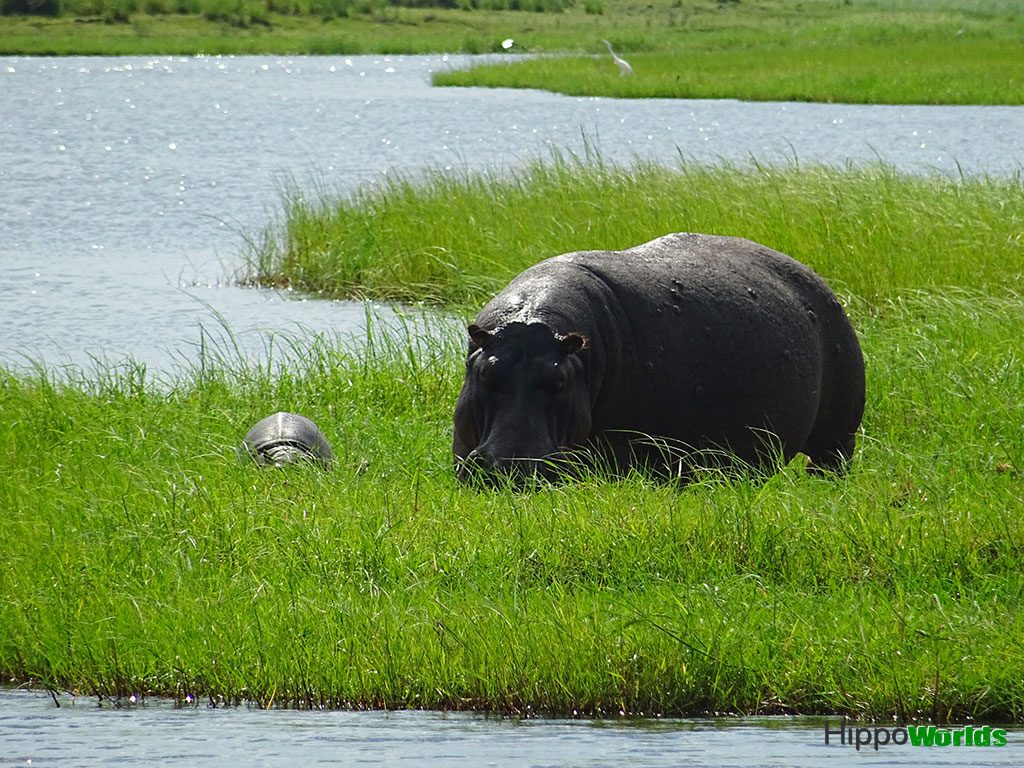
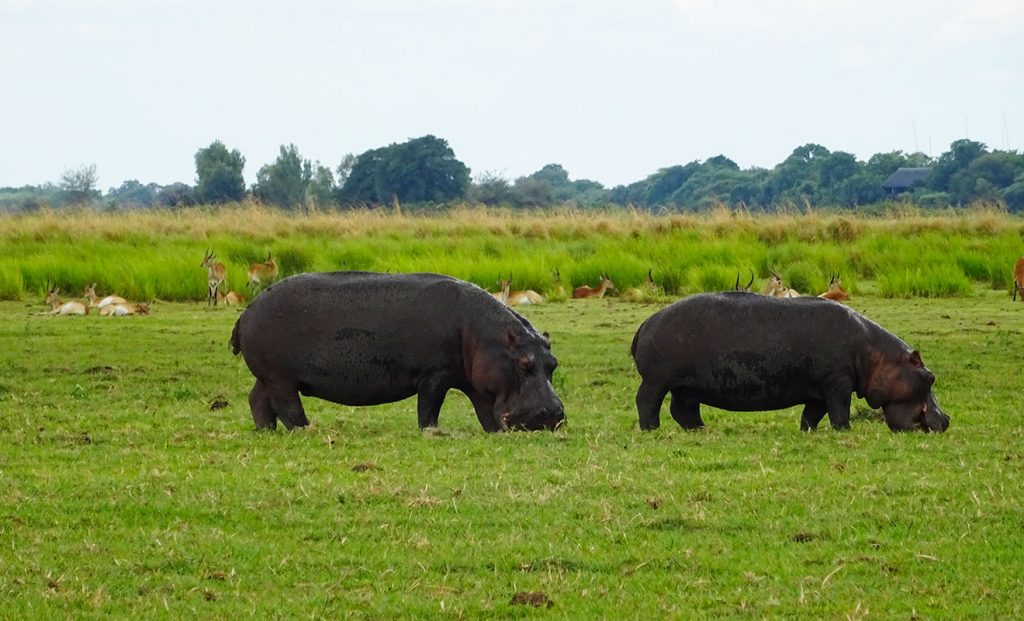
The preference for short grass is specific. Hippos graze with their wide, muscular lips — pulling clumps of grass from the ground with a sideways tug of the head — and they are most efficient on the kind of short, dense turf found on African floodplains and river margins. They do not browse trees, do not dig for roots, and are not attracted to the tall grass that many other African grazers consume.
Despite popular belief, hippos are not omnivores. The rare documented cases of hippos consuming meat — carrion, fish that wash up in pools, or occasionally other animals during overcrowded dry-season conditions — are exceptions that reflect nutritional desperation or opportunism, not a natural dietary tendency. Scientifically, the common hippopotamus is classified as a herbivore. We cover these exceptional cases in detail in our do hippos eat meat guide.
How Much Do Hippos Eat?
An adult hippopotamus consumes approximately 35 to 40 kg (77 to 88 lbs) of grass per night on average — a figure confirmed across multiple wildlife research institutions including the San Diego Zoo Wildlife Alliance and the Smithsonian’s National Zoo. For an animal of its size, this is a modest intake — adult elephants consume 150 to 300 kg of vegetation daily, and even white rhinoceroses consume proportionally more.
The reason hippos can sustain themselves on relatively little is their semi-aquatic lifestyle. An animal that spends 16 hours per day largely motionless in water burns far fewer calories than one that is walking, hunting, or maintaining body temperature in open air. The energy saved by staying in water during the day is effectively subsidising the efficiency of the hippo’s diet.
When and How Hippos Feed
Hippos are nocturnal grazers. They leave the water after sunset and return before dawn, spending approximately 5 to 6 hours foraging on land — not 16 hours, which is the time they spend in water.
During this nightly window, they may travel 5 to 10 km (3 to 6 miles) from the water’s edge. They follow established paths — the well-worn “hippo highways” trampled through vegetation by generations of the same pod — between the river and the best available grazing areas.
The feeding session is largely solitary in the sense that hippos do not herd together while grazing the way they aggregate in water. They spread out across the available grassland, and the social hierarchies of the water territory largely dissolve during the nighttime feeding period. Hippos from rival pods may graze on the same floodplain without conflict, because land is essentially neutral territory.
Before dawn, they return to water along the same established routes.
This nocturnal grazing pattern is well documented by field researchers, including detailed behavioural studies published by the African Wildlife Foundation.
The Digestive System: A Pseudo-Ruminant
The hippopotamus has a three-chambered stomach capable of fermenting plant material in a process similar to that of true ruminants such as cattle, sheep, and deer. This fermentation allows the hippo to extract significantly more nutrition from grass than a simple single-stomach system would allow.
However, hippos are classified as pseudo-ruminants rather than true ruminants because they do not chew cud. In a true ruminant, fermented material is regurgitated and re-chewed before final digestion. Hippos do not do this — food passes through the fermentation chambers and continues to digestion without returning to the mouth.
This digestive system is well-suited to a herbivore that needs to process large quantities of fibrous grass quickly during a limited nighttime window, without the time investment of cud-chewing. The Smithsonian’s National Zoo notes that this fermentation process is what allows hippos to extract sufficient nutrition from a diet that would be inadequate for many other large herbivores.
The Ecological Role of Hippo Feeding
The hippopotamus is frequently described as an ecosystem engineer — an animal whose feeding and movement patterns have structural effects on the environment around it that extend far beyond its individual impact.
Nutrient Cycling
Every night, hippos move from river to grassland to feed, and every day they return to the water. In the process, they transport nutrients from the terrestrial ecosystem into the aquatic one through their dung — which is deposited almost entirely in water.
A single adult hippo produces approximately 8 kg of dung per day. This dung is rich in silica, nitrogen, and other nutrients that drive the productivity of the aquatic food web — supporting the algae, invertebrates, and fish that in turn support the dozens of bird and mammal species that depend on Africa’s river systems.
Research led by ecologists at Yale University and the Cary Institute of Ecosystem Studies found that the hippo population of Kenya’s Mara River collectively deposits approximately 8,500 kg (9.3 tons) of partially digested plant material into the river every single day. The same study, published in the journal Nature Communications, found that this massive nutrient input can also trigger periodic oxygen crashes and fish kills downstream — showing that the hippo’s ecological role, while essential to the health of African rivers, is also a powerful force capable of disrupting them.

Hippo Highways and Water Channels
The paths hippos create between water and grazing areas — used repeatedly by generations of the same pod over decades — become significant landscape features. These compacted trails act as drainage channels during heavy rainfall, directing surface water back toward rivers and creating small-scale irrigation effects on adjacent grassland. Some researchers argue that hippo movement patterns have historically helped to maintain the structure of African floodplain ecosystems in ways that are not well understood.
Hippos and Agriculture
The nocturnal feeding behaviour that keeps hippos ecologically valuable also puts them in direct conflict with human communities across sub-Saharan Africa.
Agricultural fields planted near rivers — which frequently occupy the same floodplain grassland that hippos have grazed for millennia — are vulnerable to nighttime raids. A single adult hippo consuming 40 kg of vegetation per night can devastate a field of maize or sweet potato in a single visit. Multiply this across a pod and the damage to small-scale subsistence farmers can be severe.
This human-wildlife conflict is one of the primary drivers of hippo mortality across West and Central Africa. Farmers who lose their crops to hippo raids often retaliate by killing the animals responsible — sometimes legally, sometimes not. Managing this conflict is one of the central challenges of hippo conservation, and is a core focus of the IUCN SSC Hippo Specialist Group, the leading global body coordinating conservation efforts for both hippo species.
Pygmy Hippo Diet: A Different Approach
The pygmy hippopotamus (Choeropsis liberiensis) has a considerably more varied diet than the common hippo — reflecting its different habitat and lifestyle.
Where the common hippo is a specialist grazer on short grassland, the pygmy hippo is an intermediate forager, consuming a mix of:
- Ferns and broad-leaved plants
- Fallen and low-hanging fruit
- Roots and tubers
- Some grass
- Aquatic plants
This dietary flexibility reflects the pygmy hippo’s forest environment, where the dense, mixed vegetation of Central and West African rainforests offers a very different menu from the open floodplain grasslands that sustain the common hippo. The Pygmy Hippo Foundation — which works alongside the Zoological Society of London on pygmy hippo research and protection — notes that this varied diet is one of several key differences between the two living hippo species.

Frequently Asked Questions
- What do hippos eat? Hippos eat grass — almost exclusively. An adult hippopotamus consumes approximately 35 to 40 kg of short grass per night during a foraging session of 5 to 6 hours. They occasionally eat fallen fruit, aquatic plants, and other vegetation, but grass is the overwhelming majority of their diet.
- Are hippos herbivores or omnivores? Hippos are classified as herbivores. Their natural diet is plant-based, consisting almost entirely of grass. Rare documented cases of hippos consuming meat exist but are considered exceptional behaviour rather than a normal dietary pattern. We cover these cases in our do hippos eat meat article.
- How much does a hippo eat per day? An adult hippopotamus eats approximately 35 to 40 kg (77 to 88 lbs) of grass per night — which for an animal weighing up to 3,200 kg is a relatively modest intake. Hippos can sustain themselves on less food than most comparably sized animals because their semi-aquatic lifestyle is exceptionally energy-efficient.
- Do hippos eat during the day? No. Hippos spend up to 16 hours per day in water, largely inactive. They graze at night, leaving the water after sunset and returning before dawn in feeding sessions that typically last 5 to 6 hours.
- Do hippos eat fish? Normally, no. Hippos are herbivores. However, documented cases of hippos consuming fish, small animals, and carrion exist — behaviour most commonly associated with nutritional stress during drought conditions or extreme overcrowding. These are exceptions, not part of the typical diet.
- How far do hippos travel to feed? Hippos typically graze within 5 to 10 km (3 to 6 miles) of their water source, travelling along established paths between the river or lake and the grazing area. In areas where good grassland is scarce, they may travel further.
- Why is hippo dung important for rivers? Hippo dung deposited in rivers delivers significant quantities of nutrients — silica, nitrogen, and organic matter — from the terrestrial ecosystem into the aquatic one. Research has shown that hippo-derived nutrients are a critical driver of river productivity in East African ecosystems, supporting algae, invertebrates, fish, and the species that feed on them.
Explore more on Hippoworlds: do hippos eat meat? · hippopotamus anatomy · hippo blood sweat — the red skin secretion · where to see hippos in the wild · pygmy hippo diet and lifestyle

I’ve been writing and running HippoWorlds’ content since 2019. I lived in Angola and was lucky enough to see hippos in the wild in Botswana and South Africa — I’m not a scientist, but a curious enthusiast dedicated to making this site a serious reference on the species.