

Last Updated on August 10, 2026 by Jorge Bastos
The reddish liquid that appears on a hippopotamus’s skin on a hot day has been misidentified, mythologised, and misunderstood for thousands of years. Ancient cultures thought hippos were sweating blood. Medieval physicians attempted to use it as medicine. Even today, the claim that hippo milk turns pink because of it circulates widely online.
None of this is true. Hippo “blood sweat” is not blood, not sweat, and does not turn hippo milk pink. What it actually is turns out to be far more interesting than any of those myths: a unique, chemically complex secretion found in no other animal on Earth, capable of simultaneously acting as a sunscreen, an antibiotic, and a skin moisturiser — produced on demand from deep within a hippo’s hide.
Blood Sweat: Quick Facts
| Feature | Detail |
|---|---|
| Common name | Blood sweat, red sweat |
| Scientific name | Hipposudoric acid (red) + Norhipposudoric acid (orange) |
| Is it blood? | No |
| Is it sweat? | No — it comes from unique skin glands |
| Colour when secreted | Clear |
| Colour after air exposure | Red to reddish-brown |
| Chemical structure | Three-ring fluorenoid nucleus |
| Primary functions | UV sunscreen, antimicrobial agent |
| UV absorption range | 200–600 nm (broad spectrum) |
| Discovered | 2004, Nature journal |
| Research team | Kyoto Pharmaceutical University, Japan |
| Unique to hippos? | Yes — found in no other known animal |
| Pygmy hippo equivalent | Present, appears lighter/pinkish |
What Is Hippo Blood Sweat? Clearing Up Three Myths
Before getting into what hippo blood sweat actually is, it helps to clear up what it is not.
Myth 1: It is blood. The reddish colour is convincing, but the secretion contains no blood cells, no haemoglobin, and no components of blood. Ancient observers — including Pliny the Elder, who described hippos “sweating blood” in his first-century encyclopaedia Naturalis Historia — can be forgiven for the confusion. Modern observers who repeat this claim cannot.
Myth 2: It is sweat. Human sweat is produced by eccrine glands near the surface of the skin and is composed primarily of water, salt, and trace minerals. Hippo secretion comes from a different type of gland entirely, produces a different kind of fluid, and serves different biological functions. The term “blood sweat” is a colloquial misnomer that has stuck despite being chemically inaccurate on both counts.
Myth 3: It turns hippo milk pink. This claim is repeated across dozens of websites and has appeared in otherwise credible publications. It is false. Hippo milk is white or beige in colour. It has been both widely and falsely reported that hipposudoric acid colours hippo milk pink. The confusion likely arose from the association of the secretion with a reddish hue, combined with the visual similarity between diluted pink liquid and tinted milk.
What Is It Really? The Science
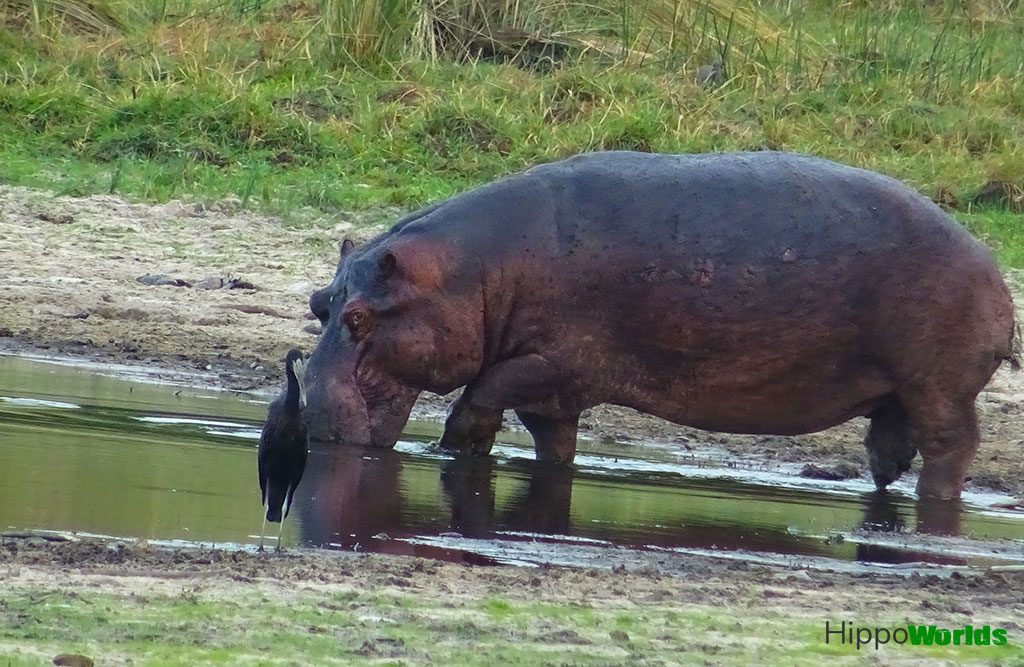
The secretion is produced by specialised glands — found only in hippos — that open directly onto the surface of the skin. Hippo perspiration erupts from deep within those two-inch-thick hides, and it is more viscous than human sweat.
The chemists eventually discovered that hippo sweat is a clear liquid when it emerges from the skin: only after a few minutes’ exposure to air does it turn crimson. The colour change happens through oxidation — the same basic chemical process that turns a cut apple brown or rusts iron. Without air exposure, the secretion is essentially invisible.
The brilliant red and orange coloration of the secretion is due to the presence of two highly acidic pigment compounds. The primary red pigment is named hipposudoric acid, and its orange counterpart is called norhipposudoric acid. Both are chemically classified as conjugated organic compounds that absorb light in the visible spectrum.
These pigments are not obtained from the hippo’s diet but are synthesised internally by the animal through metabolic pathways. The compounds are thought to be derived from the amino acid tyrosine, which is a common building block for many biological molecules. More specifically, research by Hashimoto et al. at Kyoto Pharmaceutical University confirmed that hipposudoric acid is derived from the oxidative dimerisation of homogentisic acid — a compound produced during the breakdown of tyrosine.
The final colour displayed on the hippo’s skin is determined by the specific ratio of the red hipposudoric acid to the orange norhipposudoric acid in the mixture. This means the secretion’s appearance varies from animal to animal and from day to day, ranging from pale orange to deep reddish-brown depending on the balance between the two compounds.
The chemical structure of these pigments is based on a three-ring fluorenoid nucleus. This structure is what makes both compounds highly reactive — they tend to polymerise (link together into long chain molecules) rapidly when removed from the hippo’s body or from a water environment, which is one reason they proved so difficult to analyse in the laboratory.
The Three Functions
1. Natural Sunscreen
The most critical function of hipposudoric acid is UV protection. Hippos have an unusual problem: they are large, hairless mammals who spend significant time out of the water in direct equatorial sunlight, yet they have a thin epidermis that leaves the underlying dermis highly exposed to ultraviolet radiation.
Because the compounds absorb light in the UV-visible range (200–600 nm), the researchers suspect that the pigments protect the hippo’s dermis like a sunscreen does. The hippopotamus has a thin epidermis, which exposes the sensitive dermis to UV rays.
An absorption range of 200 to 600 nm is broad-spectrum by any standard. Commercial human sunscreens are generally designed to absorb across the UVB range (280–315 nm) and part of the UVA range (315–400 nm). Hipposudoric acid covers both of these ranges and extends significantly beyond them into the visible light spectrum — a coverage profile more comprehensive than most synthetic sunscreens on the market.
Without this protection, a hippo that spends hours out of the water — as they regularly do during nightly grazing — would be at serious risk of sunburn and long-term UV damage to the skin.
2. Natural Antibiotic
The second major function is antimicrobial. Hipposudoric acid inhibits the growth of several species of pathogenic bacteria, acting as an effective natural antibiotic. The highly acidic nature of the compounds contributes to this effect, controlling microbial populations on the skin’s surface.
At low concentrations, hipposudoric acid inhibits the growth of bacteria. This antimicrobial action is critically important for an animal whose social interactions routinely involve severe injuries. Hippos are among the most aggressive animals in the world toward members of their own species: territorial fights between bulls are frequent, prolonged, and often result in deep gashes from those 50 cm canine teeth. An animal that sustains such wounds in a warm, bacteria-rich river environment — shared with Nile crocodiles, fish, and the organic waste of an entire pod — needs effective, continuous wound protection.
Hipposudoric acid provides exactly this: a constantly replenished layer of antimicrobial compound across the entire skin surface. A hippo does not need to reach a wound to treat it — the secretion is applied automatically and continuously to every centimetre of skin.
3. Moisturiser
The third function is hydration. A hippo’s skin dries out and cracks within hours if the animal is kept out of water in dry conditions. The secretion forms a thin film across the skin that slows moisture loss, helping the animal survive temporary periods away from water — including the five or more hours of nightly grazing that is typical for adult hippos.
This moisturising function is distinct from the other two: where the sunscreen and antibiotic effects come from the specific chemical properties of hipposudoric and norhipposudoric acid, the moisturising effect is primarily mechanical — the film simply slows evaporation.

The Discovery: Seven Years of Research
Despite being visible to the naked eye on any hippopotamus in any zoo or wildlife reserve, hipposudoric acid remained chemically uncharacterised until the twenty-first century. The compound is highly unstable when extracted — it begins polymerising almost immediately on removal from the hippo’s skin — which made laboratory analysis exceptionally difficult.
The breakthrough came from a research team at Kyoto Pharmaceutical University in Japan, led by Professor Kimiko Hashimoto. Based on the simple question, “What is the structure of the red pigment in the hippo’s sweat?”, the team devoted about seven years to this study and revealed the structures and both the chemical and biological natures of the responsible pigments.
Their findings were published in Nature in 2004, in a paper titled “The Red Sweat of the Hippopotamus.” After purifying the mixture by gel filtration and ion-exchange chromatography, the Japanese group analysed it by several spectrometric techniques. They pinned down the source of the colour to two conjugated three-ring structures: a red pigment they dubbed hipposudoric acid, and an orange one, norhipposudoric acid.
The team subsequently spent several more years working on the synthesis of the compounds in the laboratory — a significant challenge given their instability. A 2006 paper in the journal Tetrahedron confirmed the successful laboratory synthesis of both hipposudoric and norhipposudoric acids for the first time, using the Pschorr reaction to construct the fluorene nucleus.
A History of Misconceptions
The misidentification of hippo blood sweat as actual blood has roots going back at least two thousand years.
Pliny the Elder described hippos sweating blood in his first-century encyclopaedia, and the belief persisted through the medieval period. It contributed to one of the stranger chapters in medical history: a misunderstanding of hippo physiology gave rise to one of the most widespread and pointless practices in medical history. Hippo “blood” — including the sweat, and sometimes parts of the animal itself — was used in various folk and classical medical contexts as a treatment for skin conditions, partly on the basis of the observed reddish appearance.
The comparison between hippo skin physiology and human skin physiology is not entirely without scientific basis: hippos and humans both have fragile, naked, nearly hairless skin, and both sweat copiously — a rare trait among animals. The specific mechanisms and compounds are entirely different, but both species face the same basic challenge of managing a large, hairless body in a warm environment.
Can It Help Humans? Pharmaceutical Potential
The properties of hipposudoric acid have attracted interest beyond pure biology. Two areas of pharmaceutical research have been identified:
Sunscreen Applications
The broad-spectrum UV absorption profile of hipposudoric acid has prompted interest in its potential as a model for next-generation sunscreens. Synthetic sunscreen compounds typically require multiple active ingredients to cover the full UVA and UVB spectrum. A single compound with the absorption range of hipposudoric acid would, in principle, require fewer ingredients to achieve the same coverage. The challenge remains stability: hipposudoric acid polymerises readily, making it difficult to formulate into a stable topical product. Research into synthetic analogues that preserve the UV absorption while improving stability is ongoing.
Anticancer Research
The telomerase enzyme is an essential factor in tumorigenesis, and there is great interest in the inhibition of telomerase as a new anticancer strategy. Hipposudoric and norhipposudoric acids, with their fluorene framework, have attracted interest as potential telomerase inhibitors. The fluorene nucleus is a structural feature found in several known anticancer compounds. Research into whether hipposudoric acid derivatives could be developed as anticancer agents remains at an early stage, but the structural properties identified by Hashimoto’s team have made it a compound of ongoing interest to medicinal chemists.
Antibiotic Applications
With antibiotic resistance becoming one of the defining medical challenges of the twenty-first century, compounds with novel antimicrobial mechanisms are of increasing interest. Hipposudoric acid’s antimicrobial properties work through its acidity and chemical reactivity rather than through the mechanisms targeted by most existing antibiotics — making it potentially useful as a template for new antimicrobial agents that resistance cannot easily overcome through existing pathways.
Does the Pygmy Hippo Produce Blood Sweat?
Yes — the pygmy hippopotamus (Choeropsis liberiensis) produces a similar skin secretion, but it appears lighter in colour: more pink or whitish rather than the deep reddish-brown of the common hippo’s secretion. Whether the compound is chemically identical to hipposudoric acid or a variant unique to the pygmy hippo has not been definitively established in published research. Given that pygmy hippos spend more time in shaded forest environments and less time exposed to direct sunlight, the UV protection demands on their secretion may be lower — which could account for the reduced pigmentation.
Frequently Asked Questions About Hippo Blood Sweat
- What is hippo blood sweat? Hippo blood sweat is a skin secretion unique to hippopotamuses, produced by specialised glands that open directly onto the skin surface. It contains two pigments — hipposudoric acid (red) and norhipposudoric acid (orange) — that together act as a natural sunscreen, antibiotic, and moisturiser.
- Is it really blood? No. It contains no blood cells, haemoglobin, or any component of blood. The reddish colour comes from two acidic pigment compounds that oxidise and turn red on contact with air. The liquid is clear when it first emerges from the skin.
- Is it really sweat? No. It is produced by glands specific to hippos and comes from deep within the skin, not from sweat glands like human perspiration. Its chemical composition has nothing in common with sweat.
- Does hippo blood sweat protect against sunburn? Yes — this is one of its primary functions. Hipposudoric and norhipposudoric acids absorb UV radiation across a range of 200 to 600 nm, providing broad-spectrum protection for the hippo’s thin epidermis during the hours it spends out of water.
- Does hipposudoric acid turn hippo milk pink? No. This is a common misconception. Hippo milk is white or beige. The skin secretion and the milk glands are entirely separate, and hipposudoric acid does not enter the milk.
- Could hippo blood sweat be used in human sunscreen? Potentially — but not directly. Hipposudoric acid is highly unstable when extracted and polymerises rapidly. Research is focused on synthesising stable analogues with similar UV-absorption properties that could be formulated into cosmetic or pharmaceutical products.
- Why did it take so long to analyse chemically? The instability of the compounds made laboratory analysis extremely difficult. The molecule begins breaking down and linking into polymers almost immediately after extraction, which frustrated earlier attempts at analysis. The Kyoto Pharmaceutical University team spent seven years developing techniques to isolate, stabilise, and characterise the compounds before publishing their findings in 2004.
- Does every hippo produce blood sweat? All common hippos produce the secretion. It is most visible on hot, dry days when the hippo is out of the water, and on young animals whose skin is particularly thin. In water, the secretion disperses. The amount and colour intensity varies between individuals.
Explore more on Hippoworlds: hippo skin and anatomy, baby hippo facts, what hippos eat, and pygmy hippo guide.

I’ve been writing and running HippoWorlds’ content since 2019. I lived in Angola and was lucky enough to see hippos in the wild in Botswana and South Africa — I’m not a scientist, but a curious enthusiast dedicated to making this site a serious reference on the species.