
Last Updated on September 9, 2026 by Jorge Bastos
Two of Africa’s largest land animals share rivers, watering holes, and vast stretches of savannah. The hippopotamus and the African elephant both rank among the most dangerous animals on the continent, both are capable of killing virtually any other animal they encounter, and both are regularly encountered by the other in the wild. Yet despite their similar status as megafauna giants, the encounters between them follow a pattern so consistent that wildlife researchers across Africa have remarked on it for decades.
Hippos almost always move out of the way.
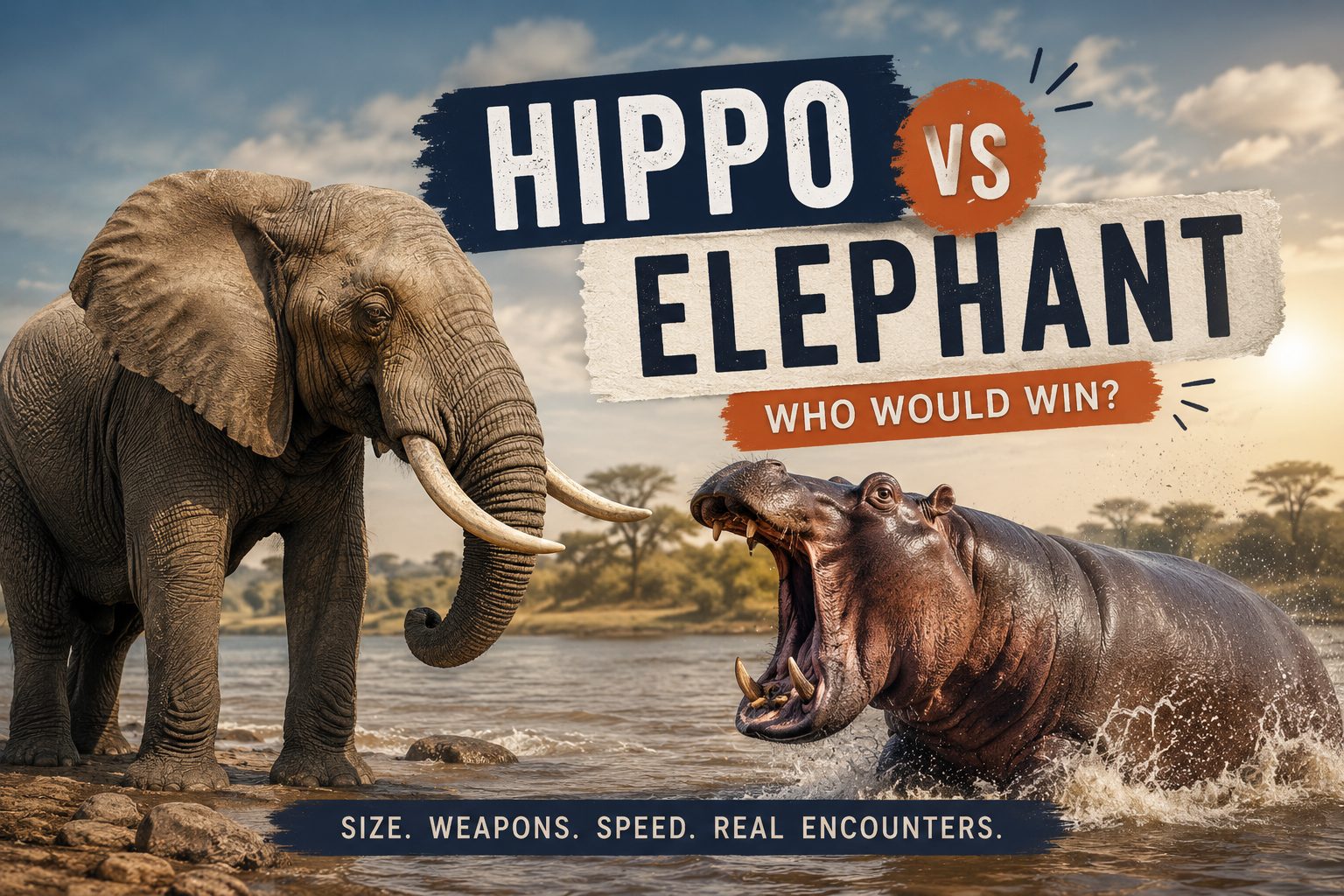
Here is the full comparison: size, weapons, speed, fighting style, real documented encounters in the wild, and a clear verdict on who would win — and why.
Hippo vs Elephant: Quick Comparison
| Feature | Hippopotamus | African Elephant |
|---|---|---|
| Scientific name | Hippopotamus amphibius | Loxodonta africana |
| Average weight (bull) | 1,500–3,200 kg (3,300–7,000 lbs) | 4,000–6,350 kg (8,800–14,000 lbs) |
| Maximum weight | ~4,500 kg (9,900 lbs) | ~10,400 kg (23,000 lbs) |
| Height at shoulder | 1.5–1.6 m (5–5.2 ft) | 3.2–4.0 m (10.5–13 ft) |
| Length | Up to 5 m (16.4 ft) | Up to 7.5 m (24.6 ft) |
| Bite force | ~1,800 PSI | ~350 PSI |
| Primary weapons | Canine teeth (up to 50 cm) | Tusks (up to 3 m), trunk, feet |
| Speed on land | ~30 km/h (19 mph) | 25–40 km/h (15–25 mph) |
| Skin thickness | ~5 cm (2 in) | ~2.5 cm (1 in) |
| Diet | Herbivore | Herbivore |
| Daily food intake | ~40 kg (88 lbs) | 150–300 kg (330–660 lbs) |
| Intelligence | High | Exceptional |
| Conservation status | Vulnerable | Vulnerable / Endangered |
Size and Weight: The Defining Difference
The single most important factor in any encounter between a hippo and an elephant is the same factor that governs most large-animal conflicts in the wild: mass.
The Elephant’s Size Advantage
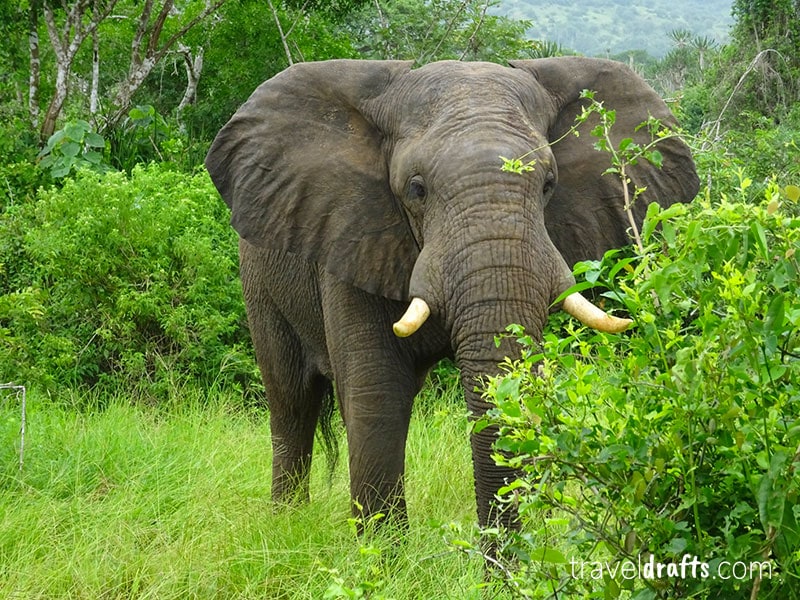
The African elephant is the largest land animal on Earth. A typical adult bull stands 3.2 to 4.0 m (10.5 to 13 ft) at the shoulder and weighs between 4,000 and 6,350 kg (8,800 to 14,000 lbs). Exceptional individuals have been recorded at over 10,000 kg — more than three times the weight of the heaviest hippo ever documented.
To put that in physical terms: a large bull elephant carries roughly the same mass as a fully loaded double-decker bus. When that mass moves at speed — in a charge — it generates force that can uproot trees, flip vehicles, and instantly incapacitate virtually any animal it contacts.
The elephant’s height is equally significant. Standing up to 4 m at the shoulder, a bull elephant looks down at an adult hippo from a height roughly equivalent to two and a half hippos stacked. This height differential is not merely visual — it determines reach, leverage, and the angle at which weapons can be brought to bear.
The Hippo Is Not Small
The hippopotamus is the third-largest land mammal in the world, after the elephant and the white rhinoceros. An adult bull weighs between 1,500 and 3,200 kg, and exceptional individuals approach 4,500 kg. This is a genuinely enormous animal by any standard — heavier than any bear, any big cat, any wild bovid, and most other megafauna.
But compared to an elephant, it is significantly smaller. In a typical encounter between species, the elephant outweighs the hippo by a factor of two to three. That gap is decisive.
Weapons and Offensive Capability
The Hippo’s Weapons: Bite and Canines
The hippopotamus carries one of the most destructive single weapons of any land mammal: a mouth that opens to 150 degrees and delivers approximately 1,800 PSI through canine teeth that can reach 50 cm (20 inches) in length. A hippo’s bite has been documented severing a Nile crocodile’s body in a single closure.
However, the hippo’s bite presents a tactical limitation against an elephant. To use its jaws effectively, the hippo must get close — close enough to position its lower jaw beneath or around part of the elephant’s body. Against an animal that stands 4 m tall, that means targeting the legs, the trunk, or the lower abdomen. The elephant’s legs are among its most structurally reinforced body parts, and its trunk — while vulnerable — can be retracted rapidly.
There are documented field reports of hippos inflicting deep canine wounds on elephant legs during encounters. These wounds are painful and potentially serious, but not immediately incapacitating for an animal of the elephant’s mass.

The Elephant’s Arsenal: Tusks, Trunk, and Feet
The African elephant brings a remarkably diverse offensive toolkit to any confrontation.
- Tusks — The upper incisors of a bull elephant can reach 3 m (10 ft) in exceptional individuals, though an average of 1.5–1.8 m (5–6 ft) is more typical. Each tusk can weigh up to 45 kg (100 lbs). They are used for stabbing, pinning, and prying — and at full forward momentum, can penetrate several centimetres into the ground. Against a hippo, a tusk strike aimed at the flank or abdomen would be devastating.
- Trunk — An elephant’s trunk weighs approximately 140 kg (300 lbs) and can generate enough force to throw objects weighing hundreds of kilograms. In combat, the trunk is used as a striking weapon — a single heavy swing at a hippo’s skull or neck can cause severe trauma. The trunk also gives elephants reach that no other land animal possesses.
- Feet — An elephant foot supports approximately 1,500 kg per leg. A single stomping blow from one foot lands roughly the same force as a small car dropped from standing height. Multiple accounts from field researchers describe hippos being rendered immobile by a single stomp from an elephant that overran them during a charge.
- Sheer momentum — At 6,000 kg and 25–30 km/h in a full charge, a bull elephant generates roughly the same kinetic energy as a medium freight truck. A hippo in the direct path of a charging elephant has very limited options: move, or absorb an impact that may be unsurvivable.
Speed: Closer Than You Think
This is where the comparison becomes more interesting than most people expect.
A hippopotamus can run at up to 30 km/h (19 mph) on land — a speed that surprises most people given the animal’s bulk. An African elephant charges at speeds of 25–40 km/h (15–25 mph), with the higher end of that range sustained only briefly.
In terms of top speed, the two animals are roughly matched. The hippo may actually be marginally faster over the very shortest distances. Neither animal can sustain maximum speed for more than about 30 seconds before fatigue sets in.
The critical difference is not top speed but effective momentum: the elephant’s speed multiplied by its mass generates far greater force on impact. A hippo and an elephant charging each other at the same velocity results in an outcome decided entirely by weight — and the elephant has two to three times as much of it.
Defence and Skin
Both animals have genuinely impressive dermal armour.
A hippo’s skin reaches 5 cm (2 inches) in thickness on the sides and back — thick enough to stop most conventional weapons and to absorb considerable punishment in combat. A hippo’s hide is among the most resistant natural skin structures of any land mammal.
An elephant’s skin averages around 2.5 cm (1 inch) in thickness — thinner than a hippo’s, but covering a body so large that the total surface area of armour is far greater. Elephant skin is also reinforced by a thick subcutaneous fat layer and dense connective tissue, particularly around the skull, neck, and shoulder.
Both animals have thick enough skin that each other’s primary weapons — hippo canines, elephant tusks — require real force and accurate placement to cause life-threatening injury.
Intelligence as a Factor
The African elephant is among the most cognitively sophisticated animals on Earth. Elephants demonstrate self-recognition in mirrors, advanced tool use, persistent memory of individuals and locations over decades, complex mourning behaviours, and the ability to solve multi-step problems. Their social structures are built around accumulated wisdom transmitted across generations within matriarchal herds.
In combat terms, elephant intelligence matters in several ways. Field observers report that elephants engaging in conflict assess the situation before committing to a full charge, use feints and mock charges to test an opponent’s response, and in some documented cases have targeted a competitor’s most vulnerable points — aiming trunk strikes and tusk attacks at specific anatomical weaknesses rather than simply charging blindly.
The hippopotamus is not unintelligent — there is meaningful evidence of individual recognition, social bonding, and memory within pods — but it does not approach the elephant’s cognitive capacity. In a direct confrontation, an elephant’s ability to read and adapt to the situation represents a genuine tactical advantage.
How Hippos and Elephants Actually Interact in the Wild
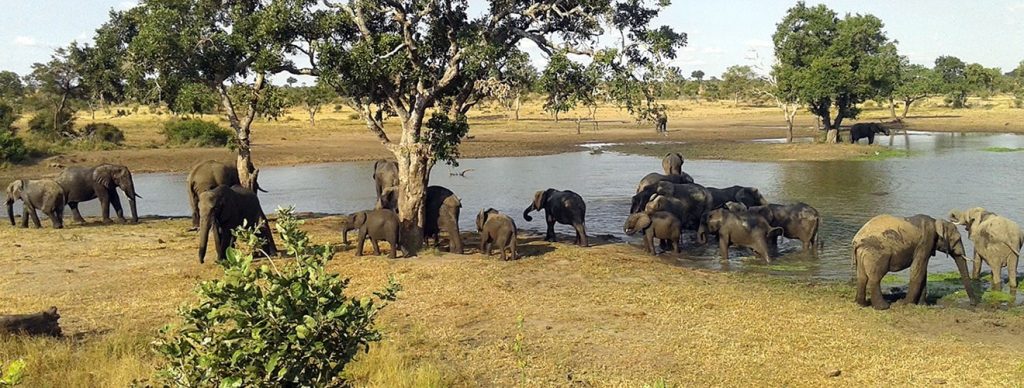
Across Africa’s major wildlife reserves — Zambia’s Luangwa Valley, Botswana’s Okavango Delta, Zimbabwe’s Hwange — field researchers and safari guides have documented the same consistent pattern in hippo-elephant encounters at shared water sources.
Hippos yield to elephants.
Not always, not instantly, and not without protest — but consistently. When a herd of elephants approaches a waterhole or river section occupied by hippos, the hippos typically move aside.
The displacement is sometimes gradual (the hippo retreats slowly as the elephants drink), sometimes faster (the hippo moves immediately when a bull elephant approaches directly). Occasionally a hippo holds its ground and the elephant is forced to go around it. But outright violent conflict is rare, and when it occurs, the outcome is consistently unfavourable for the hippo.

The Exceptions: Mothers, Musth, and Territorial Defence
Three situations make hippo-elephant encounters significantly more dangerous:
- Hippo cows with calves — A female hippo with a newborn or young calf is among the most dangerous animals on the continent, regardless of species. Field reports document cow hippos charging full-grown bull elephants that approached within their defensive perimeter. The charge is genuine and can result in injury to the elephant — but even the most determined cow hippo is ultimately outweighed by a factor of two, and most such confrontations end with the hippo retreating once the elephant responds.
- Bull elephants in musth — Musth is a periodic hormonal state in adult male elephants characterised by sharply elevated testosterone, highly aggressive behaviour, and a continuous secretion from temporal glands between the eye and ear. A bull elephant in musth is dangerous to virtually everything in its environment — other elephants, vehicles, and hippos. Multiple documented encounters describe musth bulls charging and attacking hippos without provocation, with outcomes invariably unfavourable for the hippo.
- Territorial water encounters — A hippo’s dominance peaks in and immediately adjacent to water. When an elephant pushes into a hippo’s core territorial zone — particularly at shallow crossing points where hippos control access — the hippo’s response can be much more aggressive than at open water. Field accounts from the Luangwa Valley include a bull hippo slashing an elephant’s rear leg as it crossed a shallow ford, inflicting a deep wound before retreating when the elephant turned.
Does Water Change the Outcome?
In deep water, the dynamic shifts meaningfully.
A hippo in deep water is in its natural environment. It moves at up to 8 km/h by pushing off the riverbed, can remain submerged for up to five minutes, and its entire body mass is supported by water. Its bite — its primary weapon — can be directed laterally without the postural limitations that apply on land.
An elephant in deep water is considerably less capable. It is an able swimmer, using its trunk as a snorkel, but it cannot charge, cannot stomp, and cannot use its full bodyweight as a weapon. Its tusks remain functional but require the same accurate placement as on land.
In shallow water — the most common encounter zone — both animals retain most of their land capabilities, and the size advantage still favours the elephant decisively.
In truly deep water, a hippo attacking an elephant from below — targeting the abdomen, the leg, or the throat — has a more realistic chance of causing serious injury than on open land. Whether this is sufficient to reverse the overall outcome depends on the depth, the specific animals, and how long the encounter continues. It represents the hippo’s best realistic scenario in any confrontation with an elephant.
Who Would Win? The Verdict
On land, in any standard encounter: the elephant wins, and usually without a contest.
The weight differential of two to three times is simply too large to overcome. A bull elephant’s tusks, trunk, and feet give it both reach and impact force that a hippo cannot match. The hippo’s formidable bite, while capable of injuring an elephant’s legs, requires a level of proximity that the elephant’s momentum and reach make extremely difficult to achieve consistently.
The consistency of real-world field observation confirms this: across decades of documented encounters in Africa’s major wildlife areas, the outcome of hippo-elephant conflict follows a reliable pattern. Hippos yield. When they do not yield and a fight occurs, the hippo is typically injured or killed. The reverse — a hippo killing or seriously incapacitating a healthy adult elephant — has not been reliably documented.
The one meaningful exception is a cow hippo defending a calf in extremely shallow or deep water. In that specific scenario, with the hippo’s territorial aggression at maximum and the elephant’s movement restricted by depth, the encounter is genuinely uncertain. But it remains an exception to an otherwise consistent pattern.
The hippo is not a weak animal — it is the third-largest land mammal on Earth and one of the most dangerous in Africa. Against an elephant, it simply encounters one of the very few animals on the planet that it cannot match.
Conservation: Two Giants Under the Same Threat
Despite their differences in size and temperament, hippos and elephants face nearly identical conservation pressures — and from the same source.
Both species are being pushed toward the same waterholes and rivers as their ranges contract under the pressure of agricultural expansion, human settlement, and climate-driven habitat degradation. The shrinking of available habitat increases the frequency of encounters between the two species, as both are forced into smaller areas of shared territory.
Both are targeted by poachers: elephants for their ivory tusks, hippos for their canine teeth and incisors, which are traded as ivory under a different regulatory framework. Both species are classified as Vulnerable or Endangered by the IUCN. Both have seen significant population declines in the past century.
African elephant numbers stand at approximately 415,000 individuals across the continent — a fraction of historical populations. Hippo numbers are estimated at 115,000 to 130,000 — similarly reduced. Both figures continue to decline.
The hippo that yields to the elephant at a shared waterhole in Zambia, and the elephant herd that moves on without conflict, are not just avoiding risk — they are enacting, in miniature, the same logic that has allowed two of Africa’s most dangerous animals to share a continent for millions of years.

Frequently Asked Questions
Who would win in a fight between a hippo and an elephant? In a direct confrontation on land, the elephant wins in almost all scenarios. It outweighs a typical hippo by two to three times, has greater reach with its tusks and trunk, and can deliver crushing force with its feet and bodyweight. In deep water, the outcome is less certain, as the hippo’s mobility advantage and powerful bite become more relevant.
Do hippos and elephants fight in the wild? Outright violent conflict is rare. The most consistent observed behaviour is hippos yielding to elephants at shared water sources. When conflict does occur — typically when a hippo cow is defending a calf or a bull elephant is in musth — it is usually brief and ends with the hippo retreating.
Are hippos scared of elephants? Field evidence suggests hippos recognise the elephant’s size advantage and respond accordingly, though “scared” may not be the right framing. Hippos are among the most aggressive animals in Africa and will challenge most species readily. Their consistent deference to elephants at shared water sources reflects pragmatic assessment of relative strength rather than fear in any straightforward sense.
Can a hippo bite an elephant? Yes, and it has been documented. Hippos have inflicted deep canine wounds on elephant legs, particularly during shallow-water encounters. However, a single bite, while painful, does not incapacitate an animal of the elephant’s mass. The elephant’s response to a leg bite — turning and using its full size against the hippo — is typically sufficient to end the encounter.
Which is more dangerous to humans — a hippo or an elephant? Both are among Africa’s most dangerous animals to humans. Hippos kill an estimated 500 people per year, primarily through capsizing boats. African elephants kill an estimated 100–500 people annually, though figures are inconsistent across sources. Both are unpredictable and capable of lethal force with minimal warning. Hippos are widely considered the more consistently aggressive; elephants in musth are among the most dangerous animals on Earth in that state.
Are hippos and elephants related? No. Hippos belong to the order Artiodactyla and are most closely related to whales and dolphins. Elephants belong to the order Proboscidea and are most closely related to hyraxes and manatees. The two lineages have been evolutionarily separate for over 90 million years.
Explore more on Hippoworlds:

I’ve been writing and running HippoWorlds’ content since 2019. I lived in Angola and was lucky enough to see hippos in the wild in Botswana and South Africa — I’m not a scientist, but a curious enthusiast dedicated to making this site a serious reference on the species.