
Last Updated on October 23, 2026 by Jorge Bastos
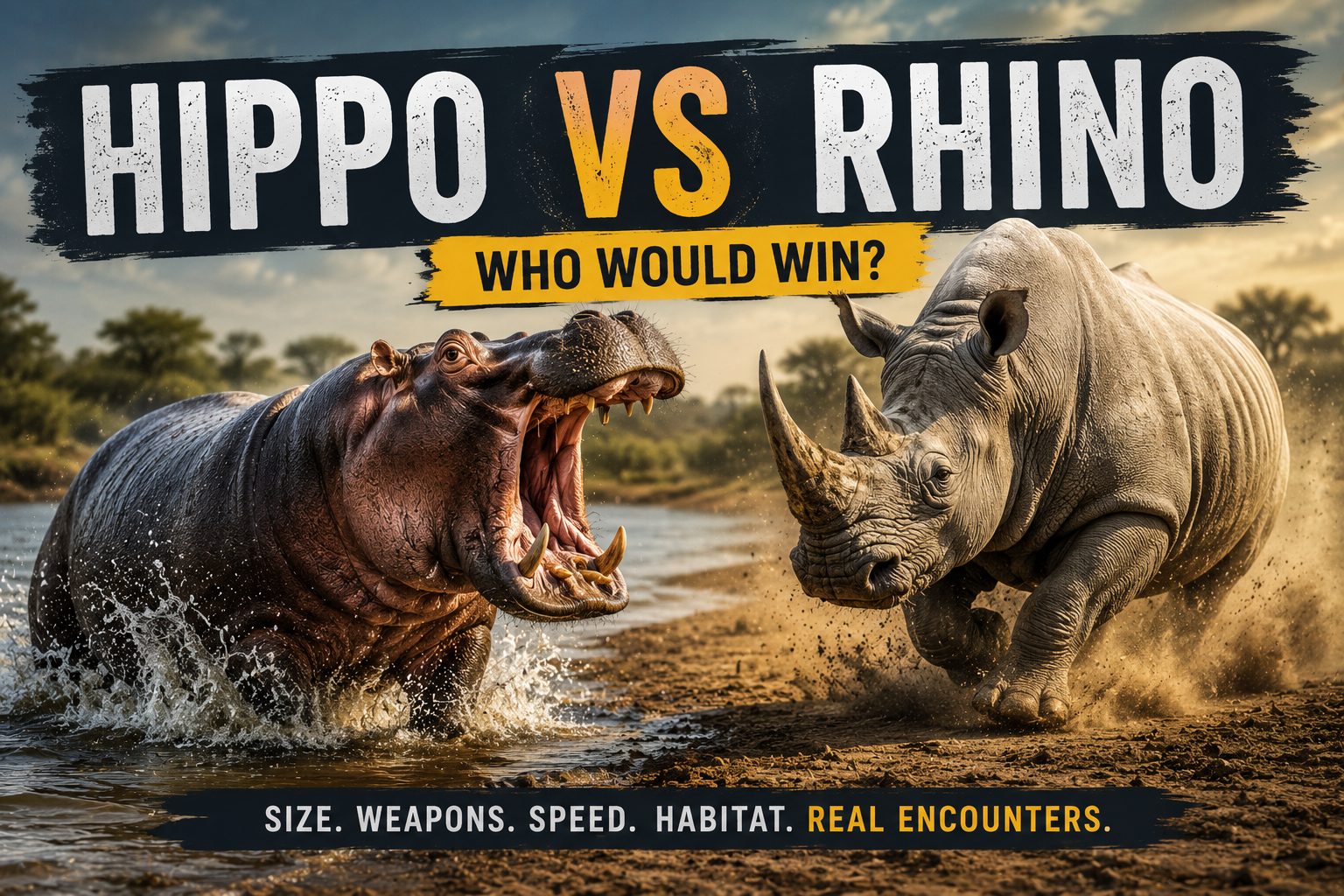
Of the three great megafauna comparisons — hippo vs crocodile, hippo vs elephant, hippo vs rhino — this is the only one where the answer is genuinely uncertain. The crocodile is outweighed by a factor of four; the elephant outweighs the hippo by two or three times. The white rhinoceros and the common hippopotamus are, by most measures, the most evenly matched large animals in Africa — similar in weight, comparable in skin thickness, and each equipped with a single devastating primary weapon the other cannot easily counter.
The outcome depends almost entirely on one variable: where the fight happens.
Hippo vs Rhino: Quick Comparison
| Feature | Hippopotamus | White Rhinoceros |
|---|---|---|
| Scientific name | Hippopotamus amphibius | Ceratotherium simum |
| Average weight (bull) | 1,500–3,200 kg (3,300–7,000 lbs) | 2,300–3,600 kg (5,070–7,920 lbs) |
| Maximum weight | ~4,500 kg (9,900 lbs) | ~3,629 kg (8,000 lbs) |
| Height at shoulder | 1.5–1.6 m (5–5.2 ft) | 1.5–1.8 m (5–6 ft) |
| Length | Up to 5 m (16.4 ft) | 3.4–4.2 m (11–13.8 ft) |
| Primary weapon | Canine teeth up to 50 cm; 1,800 PSI | Front horn up to 150 cm; charging at 50 km/h |
| Horn / tusk material | Ivory (dentine) | Keratin |
| Bite force | ~1,800 PSI | ~1,000 PSI |
| Speed on land | ~30 km/h (19 mph) | ~50 km/h (31 mph) |
| Skin thickness | ~5 cm (2 in) | ~19 mm avg, max ~45 mm |
| Vision | Good | Very poor (30 m clear range) |
| Combat frequency | Very high (constant territorial fights) | Moderate (solitary, less frequent) |
| Diet | Herbivore (grazer, night) | Herbivore (grazer, flexible) |
| Human kills per year | ~500 | Rare |
| Conservation status | Vulnerable | Near Threatened |
| Wild population | ~115,000–130,000 | ~18,000 |
Which Rhino Are We Comparing?
Before going further, it is worth clarifying which rhinoceros this comparison involves — because there are five species, and they vary considerably.
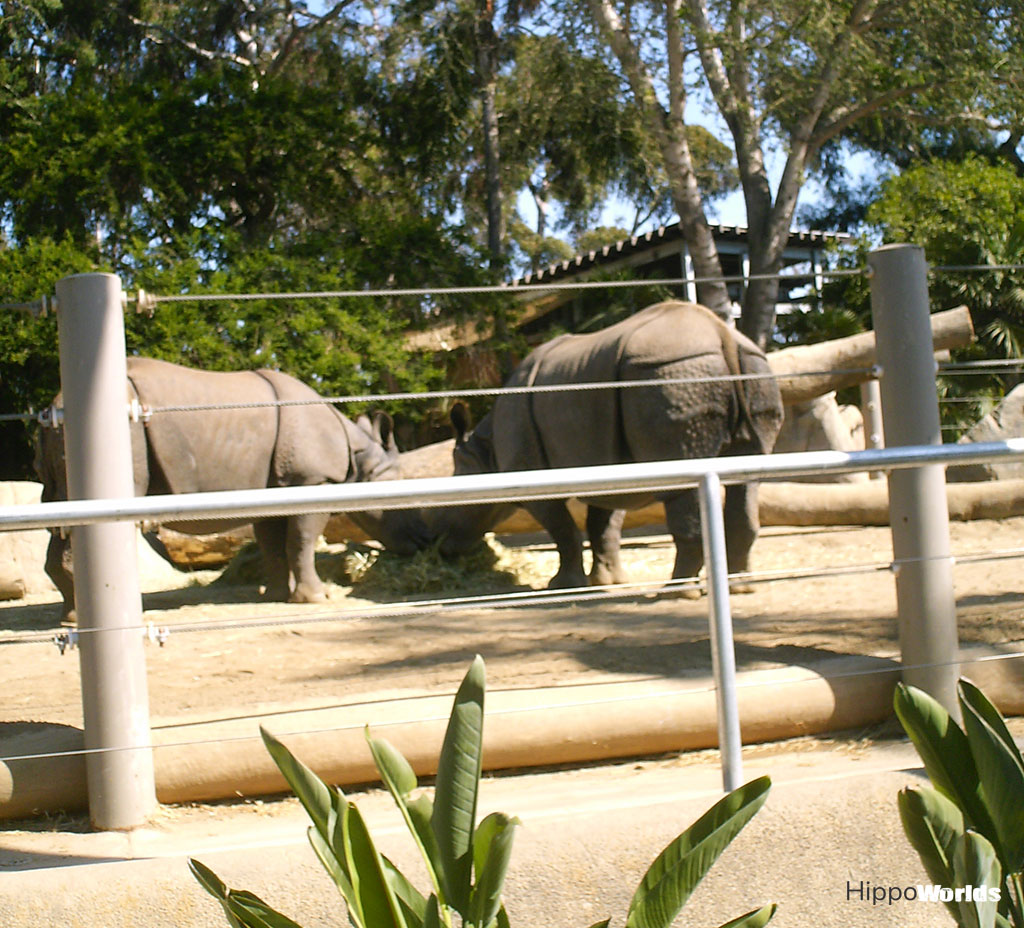
The white rhinoceros (Ceratotherium simum) is the largest rhino species and the most relevant for a comparison with the common hippo. Adult white rhino bulls weigh 2,300 to 3,600 kg, stand up to 1.8 m at the shoulder, and carry a front horn that can reach 150 cm in length. They share sub-Saharan African habitat with hippos and are the species most likely to encounter one in the wild.
The black rhinoceros (Diceros bicornis) is smaller — typically 800 to 1,400 kg — but considerably more aggressive. Black rhinos have one of the highest intraspecific combat mortality rates of any mammal: studies suggest up to 50% of males die from fights with other black rhinos. This makes them vastly more experienced fighters than their white counterparts, partially compensating for their smaller size.
The greater one-horned rhinoceros (Rhinoceros unicornis) of India and Nepal is approximately the size of a white rhino, but lives in a different ecosystem from hippos entirely.
The Sumatran and Javan rhinos are the smallest living species — both critically endangered and both restricted to Southeast Asian forests where hippos are not found.
Unless otherwise specified, this article compares the common hippopotamus with the white rhinoceros — the most physically relevant and most likely real-world encounter in Africa.
Size and Weight: Closer Than You Think
This is where the hippo vs rhino comparison diverges sharply from the hippo vs elephant matchup.
A typical adult bull white rhino weighs between 2,300 and 3,600 kg — overlapping substantially with the hippo’s range of 1,500 to 3,200 kg. The very largest individuals of both species are roughly comparable in total mass. The rhino tends to be somewhat taller at the shoulder (up to 1.8 m vs the hippo’s 1.5–1.6 m) but shorter in total body length.
Unlike the elephant matchup, where the size gap was decisive at two to three times the hippo’s weight, here both animals are operating in the same weight category. Neither can simply overwhelm the other through mass alone. This means that weapons, speed, and tactical factors carry far more weight in determining the outcome.
The Rhino’s Weapon: The Horn and the Charge
The rhinoceros’s primary weapon is not its horn in isolation — it is its horn combined with its charging speed. Considered separately, a horn is an inert structure. Combined with 3,000 kg of body mass travelling at 50 km/h, it becomes one of the most destructive natural projectiles on Earth.
The Horn
White rhino front horns average between 60 and 90 cm in length under wild conditions, though the longest recorded individual horn measured 150 cm (nearly 5 feet). The horn is composed of keratin — the same protein found in human fingernails, horse hooves, and bird beaks — compressed and hardened into a structure with tensile strength comparable to bone. It is not attached to bone itself; it grows directly from the skin over a bony protrusion on the skull.
This distinction matters in a fight: a rhino horn can be broken. Field observations from South Africa and Zimbabwe document rhinos with broken or severely worn horns, particularly bulls that fight frequently. A broken horn does not bleed or cause the animal immediate pain, but it significantly reduces its offensive capability.
The horn’s design is optimised for penetration and upward leverage: a direct hit aimed at a competitor’s flank or abdomen can puncture deep into soft tissue, while an upward sweep under the opponent’s body can flip it or disembowel it. Against the crocodile-tough hide of a hippo, a glancing horn strike leaves relatively shallow wounds. A direct impact at full charging speed is a different matter.
Charging Speed
The white rhino can reach 50 km/h (31 mph) — significantly faster than the hippo’s 30 km/h, and confirmed by Save the Rhino International, the leading conservation charity dedicated to rhino species. This speed gap is one of the most consequential differences between the two species in a confrontation. At 50 km/h, a 3,000 kg white rhino charging directly at a hippo generates kinetic energy considerably greater than the same hippo charging the rhino.
The rhino’s charging strategy is also shaped by one of its most significant biological limitations: extremely poor eyesight. White rhinos can see clearly only to about 30 metres, relying instead on acute hearing and smell — a trait also documented by Save the Rhino’s species research. In practice, this means rhinos frequently charge anything that seems threatening before fully processing what it is — an instinct that makes them dangerous in ambiguous situations but also prone to charging suboptimally, without the kind of strategic assessment a more visually acute animal might make.
The Hippo’s Weapons: Bite Force and Canines
The hippopotamus counters with what is arguably the most destructive single bite of any land herbivore: approximately 1,800 PSI delivered through canine teeth that reach up to 50 cm (20 inches) in length.
For context, the white rhino’s bite force is approximately 1,000 PSI — less than 60% of the hippo’s. The black rhino measures around 727 PSI. Neither rhino species has canine teeth of comparable length; their teeth are not combat weapons in the same way as the hippo’s. Rhinos eat, but they do not bite in combat.
In a fight, the hippo must get its lower jaw positioned below or around part of the rhino’s body to use its canines effectively. On land, this requires the hippo to manoeuvre close enough to the rhino to negate its charging distance. A hippo that closes the gap and achieves a solid grip on a rhino’s leg, neck, or skull can inflict wounds severe enough to end the fight. The question is whether it can get close enough without absorbing a horn strike in the process.
The hippo also has a psychological weapon: its aggression. Hippos are among the most confrontationally experienced large animals in Africa. Adult bulls fight each other repeatedly throughout their lives, absorbing and inflicting deep canine wounds on a near-regular basis. They are accustomed to pain, accustomed to close-range combat, and physiologically reinforced against it — older bulls show extensive scarring that attests to decades of territorial conflict.

Speed: The Rhino’s Most Significant Advantage
This is the comparison that most decisively favours the rhino on land.
At 50 km/h, the white rhino is faster than the hippo by approximately 20 km/h — a gap large enough to matter fundamentally in how a confrontation develops. The rhino can close distance faster, can disengage faster, and can position itself for a charge before the hippo can effectively respond.