
Last Updated on September 9, 2026 by Jorge Bastos
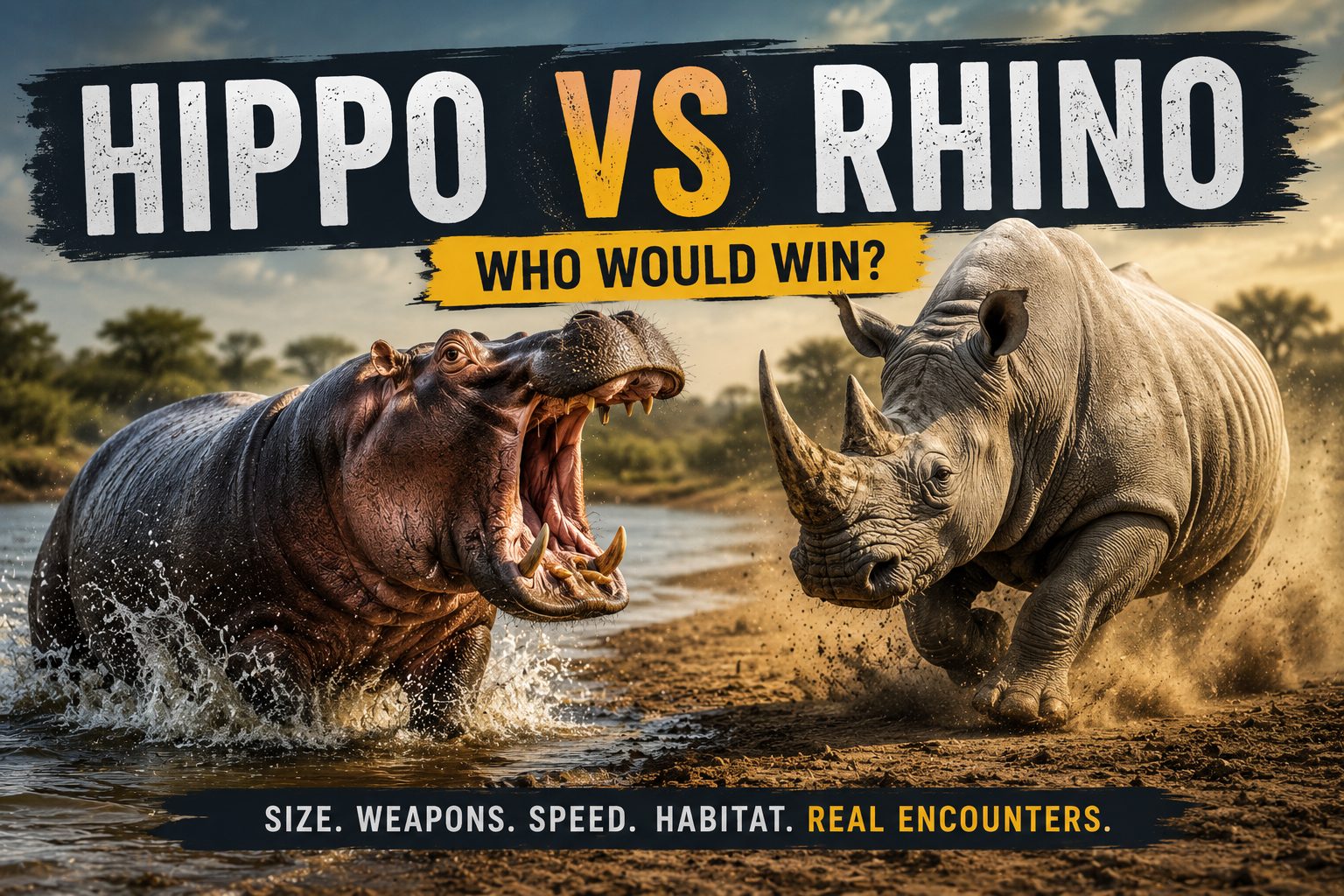
Of the three great megafauna comparisons — hippo vs crocodile, hippo vs elephant, hippo vs rhino — this is the only one where the answer is genuinely uncertain. The crocodile is outweighed by a factor of four; the elephant outweighs the hippo by two or three times. The white rhinoceros and the common hippopotamus are, by most measures, the most evenly matched large animals in Africa — similar in weight, comparable in skin thickness, and each equipped with a single devastating primary weapon the other cannot easily counter.
The outcome depends almost entirely on one variable: where the fight happens.
Hippo vs Rhino: Quick Comparison
| Feature | Hippopotamus | White Rhinoceros |
|---|---|---|
| Scientific name | Hippopotamus amphibius | Ceratotherium simum |
| Average weight (bull) | 1,500–3,200 kg (3,300–7,000 lbs) | 2,300–3,600 kg (5,070–7,920 lbs) |
| Maximum weight | ~4,500 kg (9,900 lbs) | ~3,629 kg (8,000 lbs) |
| Height at shoulder | 1.5–1.6 m (5–5.2 ft) | 1.5–1.8 m (5–6 ft) |
| Length | Up to 5 m (16.4 ft) | 3.4–4.2 m (11–13.8 ft) |
| Primary weapon | Canine teeth up to 50 cm; 1,800 PSI | Front horn up to 150 cm; charging at 50 km/h |
| Horn / tusk material | Ivory (dentine) | Keratin |
| Bite force | ~1,800 PSI | ~1,000 PSI |
| Speed on land | ~30 km/h (19 mph) | ~50 km/h (31 mph) |
| Skin thickness | ~5 cm (2 in) | ~19 mm avg, max ~45 mm |
| Vision | Good | Very poor (30 m clear range) |
| Combat frequency | Very high (constant territorial fights) | Moderate (solitary, less frequent) |
| Diet | Herbivore (grazer, night) | Herbivore (grazer, flexible) |
| Human kills per year | ~500 | Rare |
| Conservation status | Vulnerable | Near Threatened |
| Wild population | ~115,000–130,000 | ~18,000 |
Which Rhino Are We Comparing?
Before going further, it is worth clarifying which rhinoceros this comparison involves — because there are five species, and they vary considerably.
The white rhinoceros (Ceratotherium simum) is the largest rhino species and the most relevant for a comparison with the common hippo. Adult white rhino bulls weigh 2,300 to 3,600 kg, stand up to 1.8 m at the shoulder, and carry a front horn that can reach 150 cm in length. They share sub-Saharan African habitat with hippos and are the species most likely to encounter one in the wild.
The black rhinoceros (Diceros bicornis) is smaller — typically 800 to 1,400 kg — but considerably more aggressive. Black rhinos have one of the highest intraspecific combat mortality rates of any mammal: studies suggest up to 50% of males die from fights with other black rhinos. This makes them vastly more experienced fighters than their white counterparts, partially compensating for their smaller size.
The greater one-horned rhinoceros (Rhinoceros unicornis) of India and Nepal is approximately the size of a white rhino, but lives in a different ecosystem from hippos entirely.
The Sumatran and Javan rhinos are the smallest living species — both critically endangered and both restricted to Southeast Asian forests where hippos are not found.
Unless otherwise specified, this article compares the common hippopotamus with the white rhinoceros — the most physically relevant and most likely real-world encounter in Africa.
Size and Weight: Closer Than You Think
This is where the hippo vs rhino comparison diverges sharply from the hippo vs elephant matchup.
A typical adult bull white rhino weighs between 2,300 and 3,600 kg — overlapping substantially with the hippo’s range of 1,500 to 3,200 kg. The very largest individuals of both species are roughly comparable in total mass. The rhino tends to be somewhat taller at the shoulder (up to 1.8 m vs the hippo’s 1.5–1.6 m) but shorter in total body length.
Unlike the elephant matchup, where the size gap was decisive at two to three times the hippo’s weight, here both animals are operating in the same weight category. Neither can simply overwhelm the other through mass alone. This means that weapons, speed, and tactical factors carry far more weight in determining the outcome.
The Rhino’s Weapon: The Horn and the Charge
The rhinoceros’s primary weapon is not its horn in isolation — it is its horn combined with its charging speed. Considered separately, a horn is an inert structure. Combined with 3,000 kg of body mass travelling at 50 km/h, it becomes one of the most destructive natural projectiles on Earth.
The Horn
White rhino front horns average between 60 and 90 cm in length under wild conditions, though the longest recorded individual horn measured 150 cm (nearly 5 feet). The horn is composed of keratin — the same protein found in human fingernails, horse hooves, and bird beaks — compressed and hardened into a structure with tensile strength comparable to bone. It is not attached to bone itself; it grows directly from the skin over a bony protrusion on the skull.
This distinction matters in a fight: a rhino horn can be broken. Field observations from South Africa and Zimbabwe document rhinos with broken or severely worn horns, particularly bulls that fight frequently. A broken horn does not bleed or cause the animal immediate pain, but it significantly reduces its offensive capability.
The horn’s design is optimised for penetration and upward leverage: a direct hit aimed at a competitor’s flank or abdomen can puncture deep into soft tissue, while an upward sweep under the opponent’s body can flip it or disembowel it. Against the crocodile-tough hide of a hippo, a glancing horn strike leaves relatively shallow wounds. A direct impact at full charging speed is a different matter.
Charging Speed
The white rhino can reach 50 km/h (31 mph) — significantly faster than the hippo’s 30 km/h, and confirmed by Save the Rhino International, the leading conservation charity dedicated to rhino species. This speed gap is one of the most consequential differences between the two species in a confrontation. At 50 km/h, a 3,000 kg white rhino charging directly at a hippo generates kinetic energy considerably greater than the same hippo charging the rhino.
The rhino’s charging strategy is also shaped by one of its most significant biological limitations: extremely poor eyesight. White rhinos can see clearly only to about 30 metres, relying instead on acute hearing and smell — a trait also documented by Save the Rhino’s species research. In practice, this means rhinos frequently charge anything that seems threatening before fully processing what it is — an instinct that makes them dangerous in ambiguous situations but also prone to charging suboptimally, without the kind of strategic assessment a more visually acute animal might make.
The Hippo’s Weapons: Bite Force and Canines
The hippopotamus counters with what is arguably the most destructive single bite of any land herbivore: approximately 1,800 PSI delivered through canine teeth that reach up to 50 cm (20 inches) in length.
For context, the white rhino’s bite force is approximately 1,000 PSI — less than 60% of the hippo’s. The black rhino measures around 727 PSI. Neither rhino species has canine teeth of comparable length; their teeth are not combat weapons in the same way as the hippo’s. Rhinos eat, but they do not bite in combat.
In a fight, the hippo must get its lower jaw positioned below or around part of the rhino’s body to use its canines effectively. On land, this requires the hippo to manoeuvre close enough to the rhino to negate its charging distance. A hippo that closes the gap and achieves a solid grip on a rhino’s leg, neck, or skull can inflict wounds severe enough to end the fight. The question is whether it can get close enough without absorbing a horn strike in the process.
The hippo also has a psychological weapon: its aggression. Hippos are among the most confrontationally experienced large animals in Africa. Adult bulls fight each other repeatedly throughout their lives, absorbing and inflicting deep canine wounds on a near-regular basis. They are accustomed to pain, accustomed to close-range combat, and physiologically reinforced against it — older bulls show extensive scarring that attests to decades of territorial conflict.

Speed: The Rhino’s Most Significant Advantage
This is the comparison that most decisively favours the rhino on land.
At 50 km/h, the white rhino is faster than the hippo by approximately 20 km/h — a gap large enough to matter fundamentally in how a confrontation develops. The rhino can close distance faster, can disengage faster, and can position itself for a charge before the hippo can effectively respond.
The hippo’s 30 km/h is not slow — as noted elsewhere in this series, it is faster than the average human sprint. But against a charging rhino at full speed, the hippo cannot dodge laterally fast enough to avoid a direct hit, and cannot outrun the rhino to reach water if water is more than a short distance away.
The black rhino is even faster: documented charging speeds reach 55 km/h (34 mph), making it the quickest of the African rhino species despite its smaller size.
Skin and Defence: The One True Tie
A hippo’s skin reaches approximately 5 cm (2 inches) in thickness on the sides and back. A white rhino’s skin is, on average, thinner than popular accounts often suggest — dermatological data puts it at around 19 mm (0.75 in) on average, with the thickest sections reaching a maximum of roughly 45 mm (1.8 in). Both figures are below the hippo’s average. The rhino’s folded, layered skin structure — sometimes compared to plate armour — adds resilience beyond raw thickness, particularly through dense collagen reinforcement in areas most exposed to combat, but this is a partial compensation rather than genuine parity.
In practice, this means the hippo likely holds a real defensive edge in raw hide thickness. The rhino’s horn can still wound a hippo’s hide at full charging speed — the force is concentrated through a narrow tip — but the hippo’s much wider bite has an easier task cutting through the rhino’s comparatively thinner skin than the reverse.
The decisive wounds in any real encounter between these animals would require committed, sustained combat — not the kind of brief territorial display that resolves most large-animal confrontations.
Combat Experience: The Hippo’s Hidden Advantage
Here the hippo has a meaningful edge that is often overlooked in physical comparisons.
Hippopotamus bulls fight each other constantly throughout their adult lives. Territorial disputes over pod leadership and access to females involve genuine, sustained close-combat that leaves both animals with significant injuries. A dominant bull hippo has typically survived dozens of serious fights by the time it reaches its prime. It knows the mechanics of combat from repetition and physiological conditioning.
White rhino bulls, by comparison, are substantially more solitary. Serious fights do occur — primarily between bulls competing for territory and breeding access — but with much lower frequency than hippo conflicts. The rhino’s fighting instinct is less continuously exercised.
The black rhino’s combat mortality data tells a different story. The 50% male combat mortality rate among black rhinos — the highest same-species fatality rate of any large mammal — indicates that black rhinos are extremely experienced and committed fighters. In a hippo vs black rhino comparison, this experience advantage shifts meaningfully toward the rhino, even though it is the smaller of the two African species.
Vision: The Rhino’s Critical Weakness
The rhinoceros’s eyesight is notoriously poor. White rhinos can see clearly to approximately 30 metres. Beyond that distance, they identify objects primarily through smell and hearing. Their sense of smell is exceptional — among the best of any large terrestrial mammal — and their hearing is acute, but visual information in a combat situation matters.
In practice, this means a rhino in a confrontation relies heavily on its charge as a first resort. It detects a threat, assesses it primarily through smell, and charges before it has complete visual information about the target. This aggression-first response is effective as a survival strategy against most threats, but in a fight with a hippo of comparable size and destructive capability, blind charging can result in poor positioning and inefficient use of the horn.
A hippo, by contrast, has good eyesight and reasonably good sensory awareness of its environment. In a confrontation, it can track the rhino’s position and respond to the charge with more precise timing.
How Hippos and Rhinos Actually Interact in the Wild
Hippos and rhinos occupy somewhat different primary habitats — hippos require rivers, lakes, and permanent water sources, while white rhinos prefer open savanna and grassland. Their ranges overlap, however, particularly in areas like South Africa’s Kruger National Park, Zimbabwe’s Hwange National Park, and the Hluhluwe-iMfolozi Park, where both species are present.
At shared waterholes, documented behaviour between the two species is characterised primarily by mutual avoidance. Neither species consistently dominates the other in field observations the way hippos defer to elephants. The more typical outcome is that whichever animal arrives first at the waterhole holds position, and the later arrival finds another access point or waits.
When confrontations do occur, they most commonly involve a rhino perceiving a hippo as a threat and charging without complete assessment — the rhino’s poor eyesight leading it to initiate contact it might not pursue if it could see clearly. These encounters are typically brief: the hippo stands its ground, the rhino realises the scale of what it has charged, and both animals disengage.
Prolonged violent combat between hippos and rhinos in the wild has not been documented reliably. This absence of documented encounters does not mean it cannot happen — it reflects the rarity of sustained fighting between animals of this size when retreat is an option.
Water vs Land: The Variable That Decides Everything
This is the axis around which the entire comparison turns.
On Land
On open ground, the white rhino holds a genuine advantage. Its speed — 50 km/h versus the hippo’s 30 km/h — allows it to build momentum for a charge that the hippo cannot match for impact velocity. A full-speed rhino horn strike to the hippo’s flank or abdomen is capable of causing serious injury even through 5 cm of hide, because the force is concentrated through the horn’s tip at speed.
The hippo’s counterargument is its bite force and its combat endurance. If it can absorb the initial charge without being knocked off its feet, and get its jaw onto the rhino’s legs or neck, the outcome reverses. Most analysts who have studied this specific matchup consider the land fight a slight advantage for the rhino — but not a decisive one. It is a genuinely contested result that depends heavily on the individual animals and the precise sequence of engagement.
In Water
In water, the hippo wins decisively and without meaningful contest. This is true for the same reasons it is true against the crocodile: the hippo is fully adapted to its aquatic environment, moves with complete confidence below the surface, and can deliver its bite from angles the rhino cannot defend against. A rhino in deep water cannot charge effectively, cannot use its horn with force, and is fighting in an environment where it has no natural advantage. The hippo’s bite force, delivered to a rhino’s leg or abdomen from below the waterline, would be fight-ending.
The critical practical factor is proximity to water. A hippo that can reach water within a short distance has a very different strategic position than one caught on open ground far from its river. Hippos are most dangerous, most confident, and most physically capable within a short distance of water. The further from water the encounter occurs, the more the rhino’s speed and charging capability advantage increases.

Who Would Win? An Honest Verdict
Unlike the hippo vs crocodile (hippo wins decisively) and hippo vs elephant (elephant wins decisively) matchups, the hippo vs rhino comparison does not produce a clean verdict. This is the genuinely contested result in the series.
- On land, in open savanna: Slight advantage to the white rhino. The 20 km/h speed advantage is significant, and a well-executed horn charge at full speed can cause incapacitating damage before the hippo can close the distance to use its bite. The hippo’s combat experience and bite force are genuine counterweights, but the rhino’s mobility advantage is difficult to overcome on flat ground.
- Near water (within 50 metres): Advantage to the hippo. Its ability to retreat into and fight from water eliminates the rhino’s speed advantage entirely. The rhino has no equivalent environmental retreat.
- In or near water: Hippo wins clearly.
- Black rhino vs hippo: The smaller black rhino loses the weight matchup substantially but brings speed of up to 55 km/h and significantly higher combat experience. It is a credible opponent despite the size disadvantage — arguably more dangerous than a white rhino of the same size because of its aggression and fighting instincts.
The most honest answer is that the hippo and the white rhinoceros are genuinely matched animals on open land — which is why their real-world encounters typically end in mutual disengagement rather than sustained combat. Both animals recognise, at some level, that the cost of a serious fight with an equal-sized opponent is too high relative to the potential reward. They avoid each other, and the question of who would win remains, in most cases, deliberately unanswered in the wild.
Conservation: A Race Against the Same Threat
The hippo and the rhino face different conservation stories, though both are driven by the same fundamental pressures: habitat loss and the illegal wildlife trade.
Rhino Conservation
The rhinoceros is among the most critically endangered large mammals on Earth, according to assessments by the IUCN Species Survival Commission. Three of the five species face extinction within this century without intervention:
The Javan rhinoceros has fewer than 80 individuals remaining in a single location in Indonesia. The Sumatran rhinoceros numbers perhaps 80 individuals across fragmented populations in Southeast Asia. The black rhinoceros totals approximately 5,500 individuals after decades of recovery efforts following a 96% population decline between 1970 and 1992. The white rhinoceros stands at approximately 18,000 — a relative success story, but one complicated by the effective extinction of the northern white rhino subspecies, of which only two females remain in captivity.
The primary driver of rhino decline is poaching for horn, fuelled by demand in parts of Asia where rhino horn — despite being composed simply of keratin — is falsely believed to have medicinal properties. A single white rhino horn can fetch tens of thousands of dollars on illegal markets.
Hippo Conservation
The common hippo’s situation is serious but less acute than most rhino species. The global population of approximately 115,000 to 130,000 individuals is declining due to habitat loss from agricultural expansion, water source degradation, and poaching for meat and ivory teeth. The hippo was added to Appendix II of CITES in 1989, restricting international trade, but illegal hunting continues.
The pygmy hippo is considerably more endangered, with fewer than 3,000 remaining in the wild — placing it, by population numbers, in comparable territory to the black rhino.
Both animals are losing ground to the same force: the expansion of human land use into the spaces these species evolved to occupy.
Frequently Asked Questions
- Who would win in a fight between a hippo and a rhino? On open land, the white rhino has a slight advantage due to its superior speed (50 km/h versus the hippo’s 30 km/h) and the force of its horn charge. Near or in water, the hippo wins decisively. Unlike the hippo vs crocodile or hippo vs elephant matchups, this is genuinely the most evenly contested of the three comparisons.
- Are hippos and rhinos the same size? Roughly, yes — particularly when comparing the common hippo to the white rhino. Both typically weigh 1,500 to 3,600 kg and both stand 1.5 to 1.8 m at the shoulder. Maximum weights are comparable. This size parity is what makes the matchup so much more contested than hippo vs elephant.
- Which is more dangerous to humans — a hippo or a rhino? Hippos are significantly more dangerous. They kill an estimated 500 people per year in Africa, primarily through boat capsizing and territorial aggression near water. Rhinoceroses kill humans rarely — rhino attacks on people do occur, particularly from black rhinos, but the annual fatality figures are a fraction of hippo-related deaths.
- Do hippos and rhinos ever fight in the wild? Documented violent conflict is rare. Both species tend to avoid each other at shared water sources, with whichever animal arrived first typically holding position. When contact does occur, it is usually brief and ends with disengagement rather than sustained combat. Rhino charges toward hippos are most often triggered by the rhino’s poor vision leading it to initiate contact it would not pursue if it could assess the situation more clearly.
- Can a rhino’s horn penetrate a hippo’s skin? Yes, at sufficient force. A direct, full-speed horn charge can penetrate a hippo’s 5 cm hide, particularly aimed at the abdomen, flank, or throat — the thinner sections of the hippo’s dermal armour. A glancing blow is less likely to cause serious injury. Similarly, a hippo’s canines can wound a rhino’s hide, but require direct jaw placement rather than a glancing contact.
- Which rhino species is most relevant when comparing to a hippo? The white rhinoceros (Ceratotherium simum), the largest rhino species, is the most relevant comparison. It overlaps in size with the common hippo and shares sub-Saharan African habitat. The black rhino, while smaller, is more aggressive and faster. The three Asian rhino species live in different ecosystems from hippos entirely.
- Are hippos related to rhinos? No. Hippos belong to the order Artiodactyla and are most closely related to whales and dolphins. Rhinos belong to the order Perissodactyla and are more closely related to horses and tapirs. The two lineages diverged over 80 million years ago.
Explore more on Hippoworlds: hippo vs elephant · hippo vs crocodile · hippo teeth and bite force · facts abou hippos

I’ve been writing and running HippoWorlds’ content since 2019. I lived in Angola and was lucky enough to see hippos in the wild in Botswana and South Africa — I’m not a scientist, but a curious enthusiast dedicated to making this site a serious reference on the species.