

Only two species of hippopotamus survive on Earth today. That number used to be much higher — the hippo family once included species ranging from a giant African relative larger than any living hippo to a series of genuinely tiny dwarf hippos that lived, isolated, on Mediterranean islands until remarkably recently. Here’s the complete picture, living and extinct.
The Two Living Species
Common Hippopotamus (Hippopotamus amphibius)
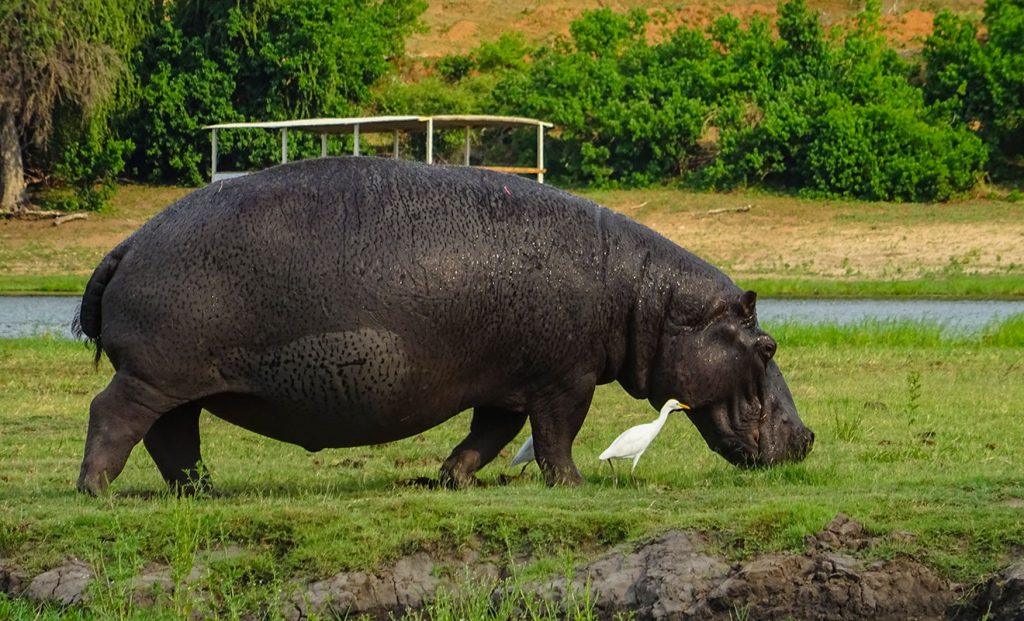
The common hippopotamus is the animal most people picture when they think “hippo” — the third-largest land mammal on Earth, weighing up to 3,200 kg, found across roughly 38 countries in sub-Saharan Africa wherever permanent freshwater exists. It’s highly social, living in pods of 10 to 30 individuals, and highly aquatic, spending up to 16 hours a day in water. Our hippopotamus anatomy guide and hippopotamus habitat guide cover the species in full detail.
Pygmy Hippopotamus (Choeropsis liberiensis)
The pygmy hippopotamus is a genuinely separate species, not a smaller version of the common hippo — roughly one-sixth the weight at 180 to 275 kg, solitary rather than social, and adapted to dense West African rainforest rather than open rivers. It survives today only in Liberia, Sierra Leone, Guinea, and Côte d’Ivoire, with a total wild population estimated at fewer than 3,000 individuals, making it considerably more endangered than its larger cousin. Our complete pygmy hippo guide covers the species’ biology, behaviour, and conservation status in depth.
| Feature | Common Hippo | Pygmy Hippo |
|---|---|---|
| Weight | Up to 3,200 kg | 180–275 kg |
| Social structure | Pods of 10–30 | Solitary |
| Habitat | Rivers, lakes | Rainforest |
| Range | ~38 African countries | 4 West African countries |
| IUCN status | Vulnerable | Endangered |
| Wild population | 115,000–130,000 | Fewer than 3,000 |
Extinct Hippo Species
The fossil record tells a much larger story than two surviving species suggests. According to the Natural History Museum, London and taxonomic records compiled on Wikipedia, at least a dozen hippo species have gone extinct, falling broadly into three groups.
The African Giant: Hippopotamus gorgops
Hippopotamus gorgops — its species name means “Gorgon-eyed,” a reference to unusually high-set eye sockets even by hippo standards — was genuinely larger than any living hippo, with estimates putting its weight at around 3,900 kg and its length at 4.3 metres. It first appeared in Africa during the late Miocene, later spreading into Europe, and is considered a likely ancestor of the European hippo species that followed it. It went extinct during the Middle Pleistocene, well before the last Ice Age.
The European Hippo: Hippopotamus antiquus
Hippopotamus antiquus ranged across mainland Europe and the British Isles during the Pleistocene — meaning hippos once lived as far north as what is now England, during warmer interglacial periods. Both this species and H. gorgops were, on average, roughly a metre longer than the modern common hippo.
Island Dwarfs: The Mediterranean’s Miniature Hippos
This is the most genuinely surprising chapter in hippo evolutionary history. As sea levels rose and fell during the Pleistocene, hippo populations became isolated on several Mediterranean islands — and, cut off from mainland resources and predators, evolved into dramatically smaller dwarf species through a well-documented evolutionary pattern called island dwarfism:
- Hippopotamus creutzburgi — Crete
- Hippopotamus minor — Cyprus, the best-studied of the group
- Hippopotamus melitensis — Malta
- Hippopotamus pentlandi — Sicily
Remarkably, the Cyprus dwarf hippopotamus survived until the end of the Pleistocene or early Holocene — meaning it may have coexisted with early human settlers on the island. Archaeological evidence from the Aetokremnos site in Cyprus has fuelled ongoing scientific debate over whether early human hunting directly contributed to the species’ extinction, a question that remains unresolved.
The Malagasy Hippos: Extinct Within the Last 1,000 Years
Perhaps the most startling entry on this list is how recently the last hippo species outside Africa’s mainland disappeared. Three species of Malagasy hippopotamus — Hippopotamus lemerlei, Hippopotamus madagascariensis, and Hippopotamus laloumena — lived on Madagascar and are now extinct, but not in some distant geological era. Radiocarbon dating of H. lemerlei bones places its extinction at roughly 1,000 years ago, and the IUCN classifies the species as having likely gone extinct sometime after 1500 CE — well within recorded human history.
These animals left a cultural trace long after their disappearance: Malagasy oral traditions recorded stories of creatures called the mangarsahoc, the tsy-aomby-aomby, the omby-rano, and the laloumena — folklore descriptions that closely resemble hippos, and strong enough as evidence that the IUCN specifically cited them when classifying the species’ extinction timeline.
Frequently Asked Questions
- How many species of hippo are there? Two living species survive today: the common hippopotamus and the pygmy hippopotamus. At least a dozen additional species are known from the fossil record but are now extinct.
- What is the biggest hippo species that ever existed? Hippopotamus gorgops, an extinct African and European species, was larger than any living hippo — estimated at around 3,900 kg and 4.3 metres long, compared to the modern common hippo’s maximum of roughly 3,200 kg.
- Did dwarf hippos really exist? Yes. Several dwarf hippo species evolved in isolation on Mediterranean islands, including Crete, Cyprus, Malta, and Sicily, through a well-documented process called island dwarfism. The Cyprus dwarf hippo survived until the end of the Pleistocene or early Holocene, potentially overlapping with early human settlement.
- When did the last non-African hippo species go extinct? The Malagasy hippopotamus species on Madagascar are the most recent, with Hippopotamus lemerlei dated to roughly 1,000 years ago and the species believed to have gone extinct sometime after 1500 CE — remarkably recent compared to most other extinct hippo species.
- Is the pygmy hippo a baby common hippo? No, despite a common misconception. The pygmy hippopotamus is an entirely separate species with its own distinct anatomy, behaviour, and range, not a young or small individual of the common hippo species.