
When Pablo Escobar was shot dead on a Medellín rooftop on 2 December 1993, Colombia’s government moved quickly to deal with the animals he had kept at his private zoo on the Hacienda Nápoles estate. The zebras, giraffes, ostriches, kangaroos, and rhinoceroses were captured, relocated, or simply died without attention. The zoo was effectively dissolved.
The hippos were different. They were too large, too dangerous, and too expensive to move. Authorities decided to leave them where they were — a decision that, three decades later, Colombia is still paying for.
How It Started: Escobar’s Private Zoo
In 1981, Pablo Escobar visited a wildlife breeding facility in Dallas, Texas, and arranged the import of four hippopotamuses — three females and one male — to his estate at Hacienda Nápoles, located between Medellín and Bogotá in the Antioquia department. The four animals were part of a broader private menagerie that Escobar assembled as a display of wealth and power, open to local communities as a gesture of goodwill.
The Hacienda Nápoles estate covered approximately 3,000 hectares and included a private airstrip, several luxury residences, sculptures of the small plane that carried his first cocaine shipment — and, at its peak, one of the most extensive private zoos in South America.
The hippos settled into the Magdalena River basin around the estate with remarkable ease. The Colombian climate — warm, wet, and fed by slow-moving tropical rivers — turned out to be very nearly ideal hippo habitat. There were no lions, no crocodiles large enough to threaten them, no drought seasons that compress African hippo populations into shrinking pools. There was, in other words, nothing to stop them.
After Escobar: Four Animals Left Behind
After Escobar’s death, Colombian authorities had neither the budget nor the infrastructure to deal with large, dangerous wildlife. Four hippopotamuses in a sprawling estate presented a logistical problem that no one was equipped to solve. They were fenced within the property — loosely — and largely ignored.
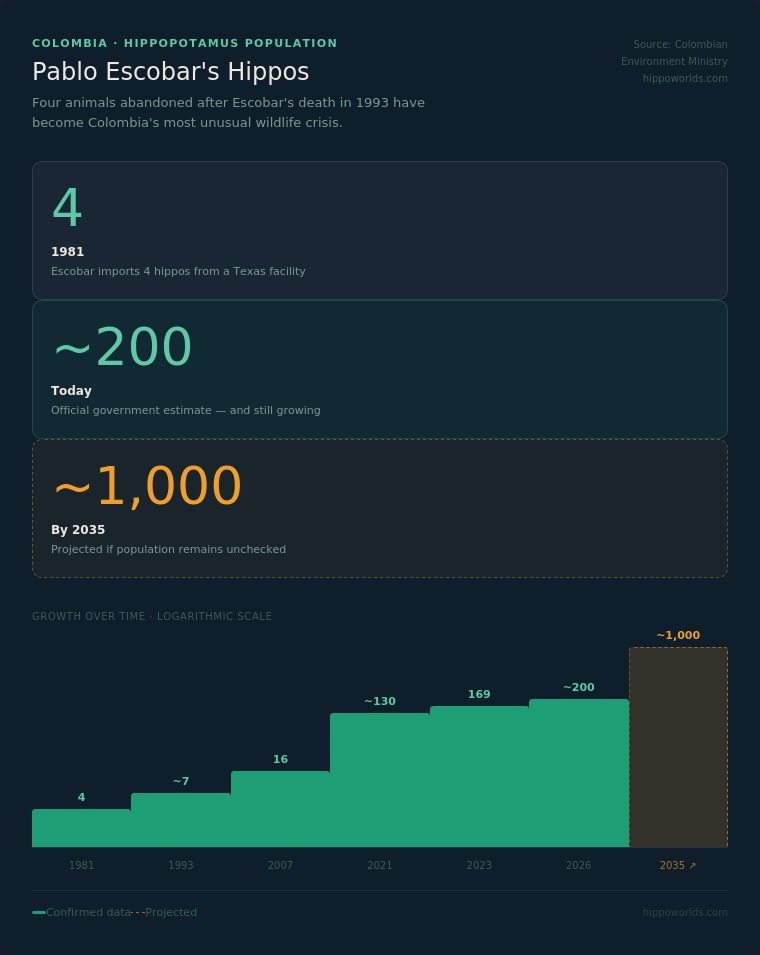
Over the following years, the fence stopped mattering. The hippos moved into the rivers, lakes, and wetlands of the surrounding Magdalena basin. By 2007, the original four had become sixteen. The reproduction rate of hippos in Colombia — unconstrained by predators, drought, or territorial competition — was higher than in their native Africa.
Few people paid serious attention. The Colombian environmental authorities were dealing with the aftermath of decades of civil conflict, drug war, and deforestation. A small group of unusual semi-aquatic mammals in a river basin was not a priority.
That changed as the numbers grew.
How Four Became Two Hundred
Female hippos reach sexual maturity at approximately five years of age and can produce a calf every eighteen months. Over a lifetime that can reach fifty years, a single female can give birth up to twenty-five times. With no natural predators in Colombia and near-ideal environmental conditions, the Hacienda Nápoles population grew steadily — and then rapidly.
By 2021, Colombian officials estimated approximately 130 hippos. By late 2023, the official government count stood at 169. Current estimates place the population at around 200 individuals, spread across the Magdalena River basin — an area covering roughly 100,000 square miles and home to approximately two-thirds of Colombia’s human population.
The projections are stark. If the population continues growing at its current rate, Colombia could have 1,000 hippos by 2035. Some models suggest 1,400 within a decade.
The Magdalena basin does not have 1,000 hippos’ worth of suitable containment. This is, in any practical sense, a crisis unfolding in slow motion.
Colombia’s Problem
In 2022, the Colombian government formally declared the descendants of Escobar’s hippos an invasive species — a designation with legal as well as ecological implications. The government has tried several approaches to slow the population growth:
- Sterilisation has been the primary tool, but it is slow, expensive, and logistically difficult. Sterilising a wild hippopotamus requires tracking the animal, sedating it in a river environment, transporting a surgical team, and performing a complex procedure — then repeating this for every hippo in a growing population. By the time one hippo is sterilised, several more have been born.
- Relocation to zoos outside Colombia has been attempted. In 2023, the Colombian government announced a plan to spend approximately $3.5 million relocating 70 hippos to sanctuaries in India and Mexico. The programme has proceeded slowly.
- Culling — the most direct solution — has been politically and socially controversial, and has been repeatedly delayed. In April 2026, the Colombian environment ministry announced a plan to euthanise up to 80 hippos, marking the first formal commitment to lethal control of the population. Environmental organisations and local communities have objected.
The ecosystem impact of 200 large herbivores in a river system that evolved without them is real and measurable. Hippos alter water chemistry through their dung, compete with native species for resources, damage riverbank vegetation, and in at least one documented case, have attacked humans in the area.
The Locals Who Love Them
The scientific and governmental consensus on the Colombia hippos is largely negative. The community consensus is considerably more complicated.
For residents along the Magdalena River near Doradal — the town closest to the original Hacienda Nápoles estate — the hippos have become, over thirty years, simply part of the landscape. Fishermen have named individual animals. Families photograph them at the river’s edge. Tourism centred on hippo sightings has become a small but real part of the local economy.
Álvaro Díaz, a fisherman who has built his livelihood partly around hippo tourism, told the Guardian in 2023: “They were born here. They’re Colombians too now.”
The Hacienda Nápoles itself has been repurposed as a theme park and tourist attraction, with the original hippopotamus lake at its centre. Visitors come specifically to see the hippos — animals that are simultaneously an ecological problem and an unexpected cultural institution.
This tension — between scientists and officials who see an invasive species spiralling out of control, and communities who see beloved neighbours — is at the heart of why Colombia has struggled to implement decisive action for over a decade.
What Happens Next
The April 2026 culling announcement represents a significant shift in Colombia’s approach. Previous governments had resisted lethal control under political pressure; the current environment ministry has framed the decision as a necessary response to a population that sterilisation alone cannot contain.
Whether the cull will be implemented at scale, and what effect it will have, remains to be seen. The hippos’ advocates — both local and international — are likely to contest it. The animals’ legal situation is also unusual: in 2021, a US federal court recognised Escobar’s Colombian hippos as “interested persons” in a case involving an Ohio zoo, in what was widely described as a first in legal history. The ruling was procedural rather than substantive, but it added a layer of legal complexity to any management decisions involving the animals.
What is clear is that the four hippopotamuses Pablo Escobar imported from Texas in 1981 have become, forty-five years later, one of the most unusual and genuinely unresolved wildlife management stories in the world. They outlasted the man who brought them. They outlasted his estate, his empire, and most of the infrastructure of the Colombian drug war. And they are still breeding.
Frequently Asked Questions
- How many hippos did Pablo Escobar have? Escobar originally imported four hippopotamuses — three females and one male — from a breeding facility in Dallas, Texas, in 1981. By the time of his death in 1993, they had begun to reproduce. Today their descendants number approximately 200 individuals.
- What happened to Pablo Escobar’s hippos after he died? When Escobar was killed in December 1993, most of his zoo animals were relocated or died. The hippos were considered too dangerous and costly to move and were left at the Hacienda Nápoles estate. They eventually escaped into the Magdalena River system and have been breeding freely ever since.
- Why are Pablo Escobar’s hippos called “cocaine hippos”? The nickname comes from their association with Colombia’s most famous drug trafficker. It is also used by international media because it is vivid and memorable, though the hippos themselves have no connection to cocaine production — they were simply part of Escobar’s private zoo.
- How many hippos are in Colombia now? As of 2025–2026, estimates place the Colombian hippo population at approximately 200 individuals, spread across the Magdalena River basin. The official government count in late 2023 was 169. The population could reach 1,000 by 2035 if growth is not controlled.
- Are Pablo Escobar’s hippos dangerous? Yes. Hippos are among the most dangerous animals in Africa and remain so in Colombia. There have been documented attacks on people in the Magdalena basin. Local residents who have grown accustomed to them sometimes underestimate the risk.
- Is Colombia going to kill the hippos? In April 2026, Colombia’s environment ministry announced a plan to cull up to 80 hippos as part of a broader population management strategy that also includes sterilisation and relocation. The decision has been controversial and is expected to be contested.
- Are the Colombia hippos an invasive species? The Colombian government formally declared them an invasive species in 2022. The scientific debate is more nuanced — some researchers argue the hippos are filling an ecological role vacated by giant herbivores that went extinct in South America thousands of years ago — but the legal and governmental position is that they represent an introduced species with negative ecological impact.
Learn more:

I’ve been writing and running HippoWorlds’ content since 2019. I lived in Angola and was lucky enough to see hippos in the wild in Botswana and South Africa — I’m not a scientist, but a curious enthusiast dedicated to making this site a serious reference on the species.