
Last Updated on September 21, 2026 by Jorge Bastos
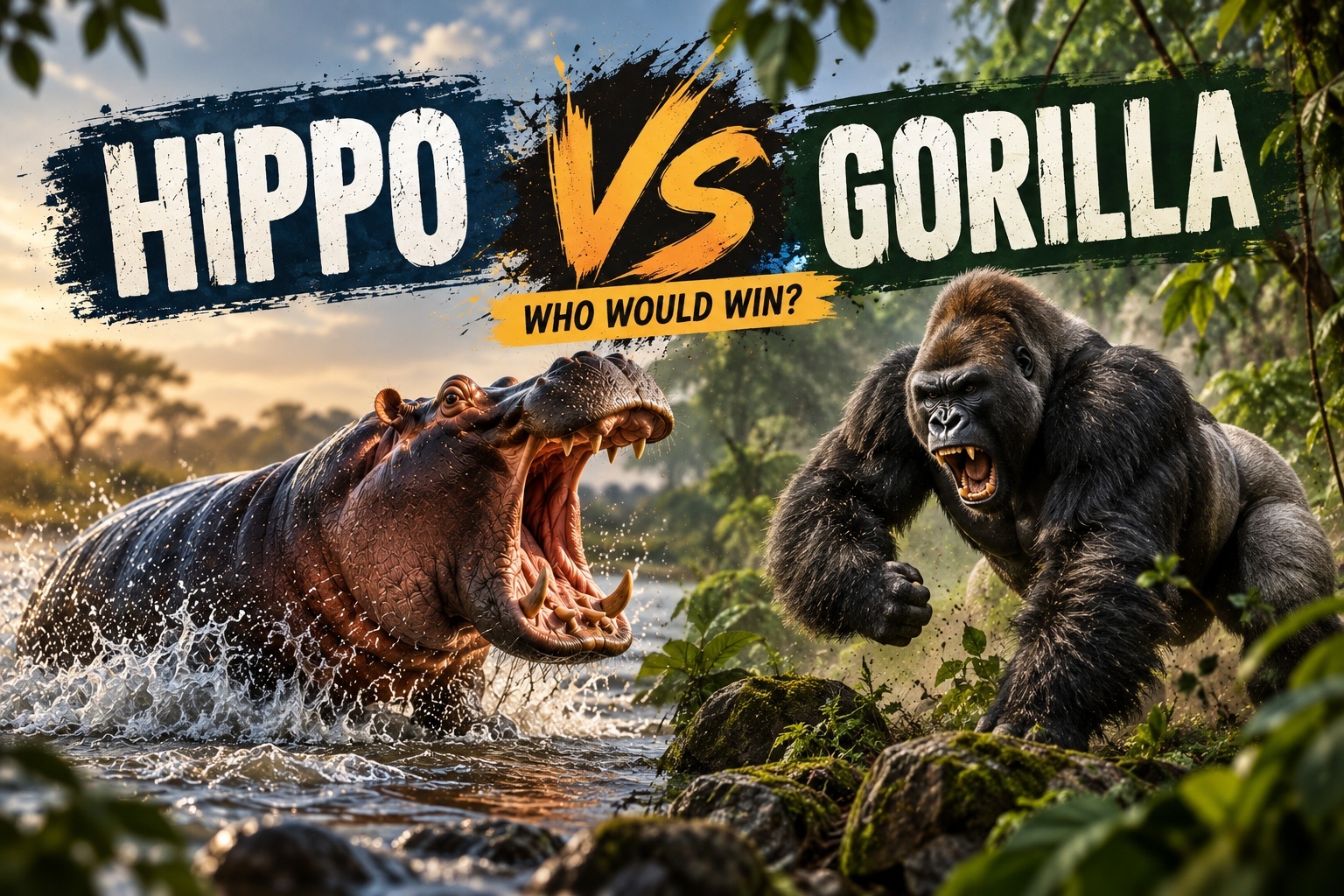
The silverback gorilla is the strongest land animal on Earth relative to its body weight. It can lift up to 815 kg — objects heavier than a grand piano — with the sustained pulling force of its upper body alone. Its bite force of 1,300 PSI exceeds that of a lion. Its canine teeth, used in combat between rival males, can reach 5 cm in length. It is intelligent, tactical, and far more experienced in real combat than most animals of comparable size.
It would still lose to a hippopotamus. And it would almost certainly know it.
This is the most intellectually interesting comparison in the series — not because the outcome is uncertain, but because the gorilla makes a more compelling case than any animal of its weight has any right to make.
Hippo vs Gorilla: Quick Comparison
| Feature | Hippopotamus | Silverback Gorilla |
|---|---|---|
| Scientific name | Hippopotamus amphibius | Gorilla gorilla / Gorilla beringei |
| Average weight (male) | 1,500–3,200 kg (3,300–7,000 lbs) | 136–200 kg (300–440 lbs) |
| Maximum weight | ~4,500 kg (9,900 lbs) | ~227 kg (500 lbs) |
| Height (standing) | 1.5–1.6 m at shoulder | 1.4–1.8 m upright |
| Arm span | — | Up to 2.7 m (8.9 ft) |
| Bite force | ~1,800 PSI | ~1,300 PSI |
| Canine length | Up to 50 cm (20 in) | Up to 5 cm (2 in) |
| Lifting strength | — | ~815 kg (1,800 lbs) estimated |
| Speed on land | ~30 km/h (19 mph) | ~40 km/h (25 mph) |
| Skin thickness | ~5 cm (2 in) | Thin, unprotected |
| Intelligence | High | Exceptional |
| Diet | Herbivore | Primarily herbivore |
| Conservation status | Vulnerable | Critically Endangered |
| Wild population | ~115,000–130,000 | ~316,000+ (western lowland); ~1,000 (mountain) |
Which Gorilla Are We Comparing?
There are two gorilla species and four subspecies, varying considerably in size and temperament.
The western lowland gorilla (Gorilla gorilla gorilla) is the most numerous and best studied, with a wild population estimated at over 316,000. Adult silverbacks typically weigh 136 to 175 kg.
The eastern lowland gorilla (Gorilla beringei graueri), also called Grauer’s gorilla, is the largest gorilla subspecies. Silverbacks average 163 to 200 kg and occasionally exceed 220 kg. Fewer than 3,500 remain in the wild.
The mountain gorilla (Gorilla beringei beringei) numbers around 1,000 individuals and lives at high altitude in Central Africa. Silverbacks are powerfully built, typically 155 to 195 kg, and are the most studied in terms of behaviour and social dynamics.
Unless otherwise specified, this article compares the common hippopotamus with a prime adult silverback, drawing from data across subspecies. The eastern lowland gorilla represents the largest individual in any realistic scenario.
Size: The Same Problem as Before
The weight comparison here is essentially identical to the hippo vs lion matchup: roughly 8 to 15 times in the hippo’s favour. An average adult hippo bull at 2,000 kg outweighs an average silverback at 160 kg by a factor of twelve. Even the largest recorded silverbacks, approaching 230 kg, face a ratio of around 8:1 against an average hippo.
This is the fundamental problem the gorilla cannot solve. Every advantage the gorilla brings to a confrontation — and it brings more genuine advantages than the lion does — runs into the same wall: the hippo is simply too large for them to matter.
The gorilla is not physically small by any ordinary standard. A 200 kg silverback with a 2.7-metre arm span is an imposing animal that most other species avoid instinctively. It is simply that the hippopotamus is not most other species.
The Gorilla’s Extraordinary Case
Pound-for-Pound Strength
The silverback gorilla is believed to be the strongest land animal relative to its body weight of any species on Earth. Estimated lifting capacity reaches approximately 815 kg (1,800 lbs) — figures confirmed by the Guinness Book of World Records, based on a 1924 study in which a gorilla exerted approximately 450 kg of pulling force in a single motion. Some researchers estimate theoretical maximum lifting capacity at up to 10 times body weight, which for a large silverback would approach or exceed 2,000 kg.
This strength is not primarily muscular in the way human strength is. Gorillas have a skeletal and muscular structure fundamentally different from humans: longer arms relative to body length, a different centre of gravity, and a concentration of fast-twitch muscle fibres that produce explosive force far exceeding what human muscles of comparable mass could generate. A gorilla can tear a banana tree out of the ground single-handed. Captive gorillas have bent iron cage bars. A silverback can reportedly throw a 360 kg object.
For context: a silverback gorilla can theoretically lift or move an object heavier than the world record for human powerlifting by a factor of two.
None of this is sufficient against a hippo. Here is why: a hippo weighs 2,000 kg. Even if the gorilla’s maximum theoretical lifting force approaches 2,000 kg — an extreme upper estimate — lifting force in a controlled environment does not translate directly to the ability to move or incapacitate an animal that is actively resisting, fighting back, and can kill the gorilla with a single contact.
Bite Force and Teeth
The gorilla’s bite force of approximately 1,300 PSI is remarkable for a primarily herbivorous animal. It exceeds that of a lion (650 PSI) by a factor of two and is actually within the same order of magnitude as the hippo’s 1,800 PSI — a much closer ratio than exists between the gorilla’s and hippo’s body weights.
Gorilla canines reach up to 5 cm (2 inches) in length — genuinely formidable teeth that can inflict serious wounds on other gorillas in intraspecific combat. They are used primarily in dominance displays and male-male conflict, and bites from silverbacks have been documented causing severe tissue damage in rival males.
Against a hippo’s 5 cm of dermal armour, a gorilla bite can cause surface damage but is unlikely to reach the muscle and organ tissue beneath. The mechanical comparison is clear: 1,300 PSI through 2 cm canines versus hide that was designed to withstand 1,800 PSI through 50 cm canines from other hippos. The gorilla’s bite is a weapon calibrated for the scale of its own species, not for an animal ten times its weight.

Intelligence and Tactical Awareness
This is where the gorilla genuinely differs from the lion as a hypothetical opponent, and where the comparison becomes most interesting.
Gorillas are among the most cognitively sophisticated animals on Earth. They have demonstrated self-recognition in mirrors, use tools in natural settings, communicate through a complex system of vocalisations and gestures, show empathy and complex social awareness, and have been documented making what appear to be tactical decisions in conflict situations. Several gorillas have learned American Sign Language in captivity, acquiring vocabularies of hundreds of signs. Their problem-solving capability is well above that of any other non-human animal except perhaps the great apes and cetaceans.
In a confrontation with a hippo, gorilla intelligence creates possibilities that a lion’s instinct-driven hunting approach does not:
- Targeting vulnerabilities. A gorilla has hands — dexterous, powerful, capable of directed force to specific anatomical points. The hippo’s most obvious vulnerabilities are its eyes, its nostrils, and the inside of its mouth. A gorilla that could reach and gouge the eyes of a hippo would cause incapacitating damage. The theoretical possibility exists in a way it does not for a lion.
- Terrain use. A gorilla can climb. A hippo cannot. A gorilla being pursued by a hippo can escape vertically — up a tree — in a way no other animal in this comparison series can. This does not change the fight outcome, but it changes the gorilla’s survival prospects significantly. A gorilla that chooses to flee upward is out of reach of a hippo immediately and permanently.
- Assessment and avoidance. The gorilla is intelligent enough to assess an adult hippo as a non-viable target before engaging. In the wild, this is almost certainly what would happen: the gorilla identifies the hippo as a threat of irresolvable scale and withdraws. This is not cowardice — it is the same calculation that has kept gorillas alive for millions of years in an environment shared with other large dangerous animals.
The Hippo’s Response
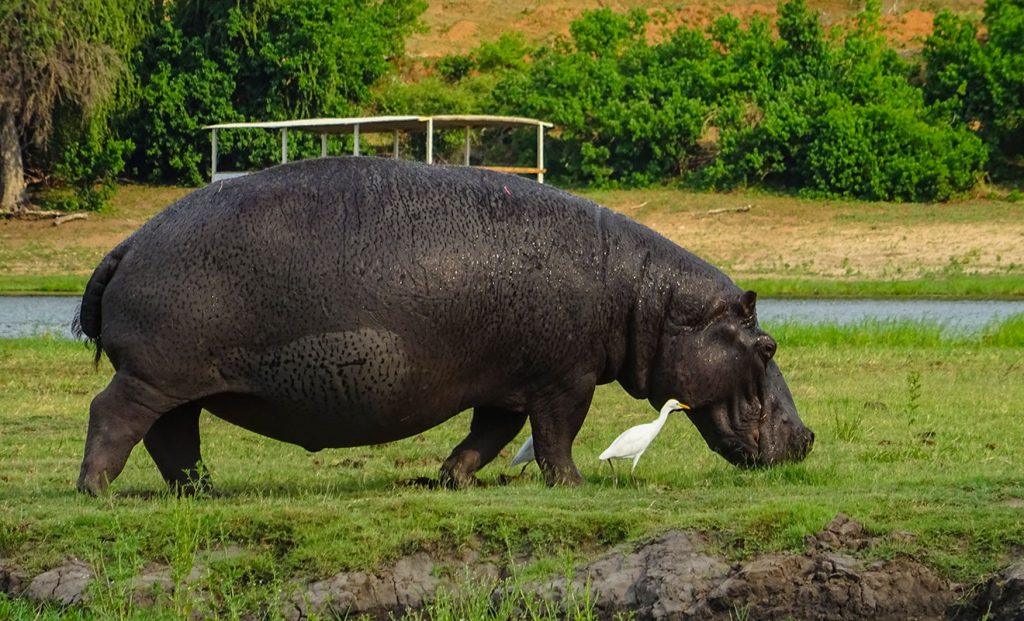
Against the gorilla’s impressive case, the hippo offers the same overwhelming physical reality it presents in every comparison: mass, hide, and a bite that operates at a different scale entirely.
A hippo’s 1,800 PSI bite through 50 cm canines is not marginally better than the gorilla’s equivalent — it is categorically different in what it can accomplish. A hippo bite that makes full contact with a gorilla’s body does not wound it. It ends the confrontation instantly. A gorilla’s entire body width is narrower than the hippo’s jaw gape.
The hippo’s charge at 30 km/h delivers kinetic energy from a 2,000 kg mass that no gorilla could resist absorbing. The gorilla is fast — reaching 40 km/h in short bursts — and could potentially avoid a charge rather than receive it. But in close proximity, on flat ground, a charging hippo does not require precise aim. Its body width is such that evasion requires the gorilla to move laterally at the moment of impact, which at the speeds involved is extremely difficult.
The hippo’s 5 cm hide provides protection against the gorilla’s most viable offensive options. A gorilla bite cannot reliably penetrate it. Gorilla hand strikes — while generating substantial force — cannot achieve the focused mechanical penetration that would be needed to cause internal damage through that thickness of dermal armour. The gorilla’s best theoretical option, eye-gouging, requires achieving and maintaining close proximity and grip on the head of an animal whose response to proximity is an immediate jaw attack of lethal force.

Do Hippos and Gorillas Actually Meet in the Wild?
Rarely — but it is not impossible.
The ranges of western lowland gorillas and common hippos overlap in parts of Cameroon, the Republic of Congo, Gabon, and the Democratic Republic of Congo, where both species inhabit areas near rivers and forest edges. In these regions, gorilla troops occasionally venture near watercourses that hippos also use, particularly during the dry season when food sources concentrate near water.
Documented interactions are extremely rare and consist primarily of gorillas recognising hippos as threats and moving away. There are no verified records of gorillas approaching, threatening, or attacking hippos in the wild. Gorilla social groups have been observed moving around areas where hippos were present, choosing routes that avoided close contact.
This avoidance behaviour is consistent with gorilla cognitive assessment: a silverback that investigates a hippo at close range, reads its body language, and retreats is not showing weakness — it is showing the same situational intelligence that makes gorillas effective at surviving in complex environments.
The Three-Environment Question
On Land
The hippo wins. The weight differential of 8 to 15 times cannot be overcome by the gorilla’s strength, bite, or intelligence under realistic combat conditions. A gorilla that stands and fights an adult hippo will be killed — almost certainly by a single charge or bite — before its own offensive capabilities can be brought to bear meaningfully.
In Water
Complete hippo dominance. The gorilla has no aquatic capability. A gorilla in deep water is defenceless and would drown or be bitten without the hippo needing to do anything unusual. Even shallow water that reaches a gorilla’s waist eliminates most of its mobility advantage and puts it on ground where the hippo is most dangerous and most confident.
In Trees
The gorilla wins its survival, if not the fight. A gorilla in a tree is completely unreachable by a hippo. Hippos cannot climb, cannot jump, and cannot pursue a gorilla vertically. A gorilla that chooses arboreal escape at the moment a hippo charges saves itself entirely. This is not a fight outcome — it is an escape outcome — but it is the most realistic outcome of a genuine wild encounter between these two species, given the gorilla’s intelligence and climbing capability.
Strength vs Mass: Where the Calculation Breaks Down
The gorilla presents the clearest possible illustration of a fundamental principle: pound-for-pound strength does not scale linearly with combat effectiveness against much larger opponents.
The gorilla can theoretically generate force approaching or matching the hippo’s body weight. But there are several reasons this does not translate to a fighting advantage:
- Resistance requires grip. To apply lifting or pulling force to an animal, you must first grip it. A gorilla’s hands on a hippo’s 5 cm hide will slip. The hippo’s smooth, wet skin offers no natural grip point, and its body is too wide for a gorilla to get its arms around in any useful way. Gorilla strength is expressed best through pulling and pushing actions against objects it can grip — a hippo’s body is not one of them.
- Force requires a stable base. A gorilla exerting maximum force needs ground purchase — its feet planted, its body braced. An adult hippo charging at 30 km/h does not give the gorilla time to establish that base. The gorilla would be struck before it could apply any meaningful force.
- Strength does not stop a bite. Even if a gorilla had sufficient strength to theoretically resist a hippo’s body weight, it cannot resist a 1,800 PSI bite closing on its head, neck, or torso. No amount of lifting strength prevents what is essentially a mechanical crushing force from operating at lethal effect.
The gorilla is the most compelling contestant in this series of comparisons because it makes the strongest case for a smaller animal’s chance against the hippo. It still loses. The hippo is simply operating at a physical scale that the gorilla’s extraordinary abilities cannot bridge.
Conservation: Two Critically Threatened Species
Both the hippopotamus and the gorilla are fighting for survival against the same underlying force — human expansion into their habitat.
Gorilla Conservation
All four gorilla subspecies are classified as Critically Endangered on the IUCN Red List, making them among the most endangered large mammals on Earth.
The western lowland gorilla has the largest population — estimated at over 316,000 — but faces severe and ongoing pressure from deforestation, bushmeat hunting, and disease (particularly Ebola, which has killed thousands of gorillas in outbreak events since the 1990s). Despite its relatively larger numbers, it is listed as Critically Endangered because of the severity of the decline rate.
The mountain gorilla numbers approximately 1,000 individuals across the Virunga Massif (spanning Rwanda, Uganda, and the DRC) and Bwindi Impenetrable National Park in Uganda. It is the only great ape subspecies whose population is currently increasing, due to intensive conservation intervention — anti-poaching patrols, veterinary support, and ecotourism that gives local communities direct economic incentive to protect gorilla habitat.
The Cross River gorilla is the most endangered gorilla subspecies, with fewer than 300 individuals remaining in a fragmented forest landscape on the Nigeria-Cameroon border.
Hippo Conservation
The common hippo’s approximately 115,000 to 130,000 remaining individuals represent a species under significant but less acute pressure than the gorilla. Habitat loss, hunting for meat and ivory teeth, and water source degradation are the primary threats. The pygmy hippo, with fewer than 3,000 individuals, faces a situation comparable in urgency to the most endangered gorilla subspecies.
The ranges where hippos and gorillas overlap — principally in Central Africa — are also among the areas of highest deforestation pressure on the continent, meaning the theoretical meeting ground of these two species is shrinking along with both their populations.
Frequently Asked Questions
Who would win in a fight between a hippo and a gorilla?
The hippo wins decisively in any direct confrontation. Despite the gorilla’s extraordinary pound-for-pound strength, the hippopotamus outweighs it by a factor of 8 to 15. The hippo’s bite force (1,800 PSI) exceeds the gorilla’s (1,300 PSI), its canines are ten times longer, and its 5 cm hide resists the gorilla’s offensive capabilities. A single hippo charge or bite would end the confrontation.
How strong is a gorilla compared to a hippo?
Pound for pound, the gorilla is far stronger — capable of lifting an estimated 815 kg despite weighing only 160 to 200 kg. The hippo’s absolute strength is greater due to its mass, but the gorilla generates more force relative to its body weight than virtually any other land animal. This strength advantage does not translate to combat effectiveness against an animal 10 times its size.
Could a gorilla’s intelligence help it beat a hippo?
Intelligence gives the gorilla options the lion does not have — targeting vulnerable areas like the eyes, using terrain for escape, and assessing the threat accurately enough to avoid engaging. However, in a forced direct confrontation, intelligence cannot compensate for the physical impossibility of the gorilla’s offensive capabilities penetrating the hippo’s defences before the hippo’s own attack proves fatal
Do gorillas and hippos ever meet in the wild?
Rarely, but it is possible in Central Africa where their ranges overlap in parts of Cameroon, the Republic of Congo, Gabon, and the DRC. Documented interactions involve gorillas recognising hippos as threats and withdrawing. No verified cases of gorillas attacking or being attacked by hippos in the wild exist.
Is a gorilla’s bite stronger than a hippo’s?
No. The hippo’s bite force of approximately 1,800 PSI exceeds the gorilla’s 1,300 PSI. The gorilla’s bite is remarkable for a primarily herbivorous animal — nearly twice a lion’s bite force — but it is not the strongest in this comparison.
Could a gorilla escape a hippo?
Yes — by climbing. A gorilla being charged by a hippo on land near trees has a realistic escape route that no other animal in this comparison series possesses. The gorilla’s climbing capability means that vertical escape immediately takes it out of the hippo’s reach entirely. In the wild, this is almost certainly what a gorilla would do.
Are gorillas and hippos related?
No. Gorillas are primates — great apes, classified in the order Primates — and are most closely related to humans, chimpanzees, and other apes. Hippos are even-toed ungulates, classified in the order Artiodactyla, and are most closely related to whales and dolphins. The two lineages diverged over 80 million years ago.
Explore more on Hippoworlds: hippo vs elephant · hippo vs rhino · hippo vs crocodile · hippo vs lion · hippo teeth and bite force

I’ve been writing and running HippoWorlds’ content since 2019. I lived in Angola and was lucky enough to see hippos in the wild in Botswana and South Africa — I’m not a scientist, but a curious enthusiast dedicated to making this site a serious reference on the species.