
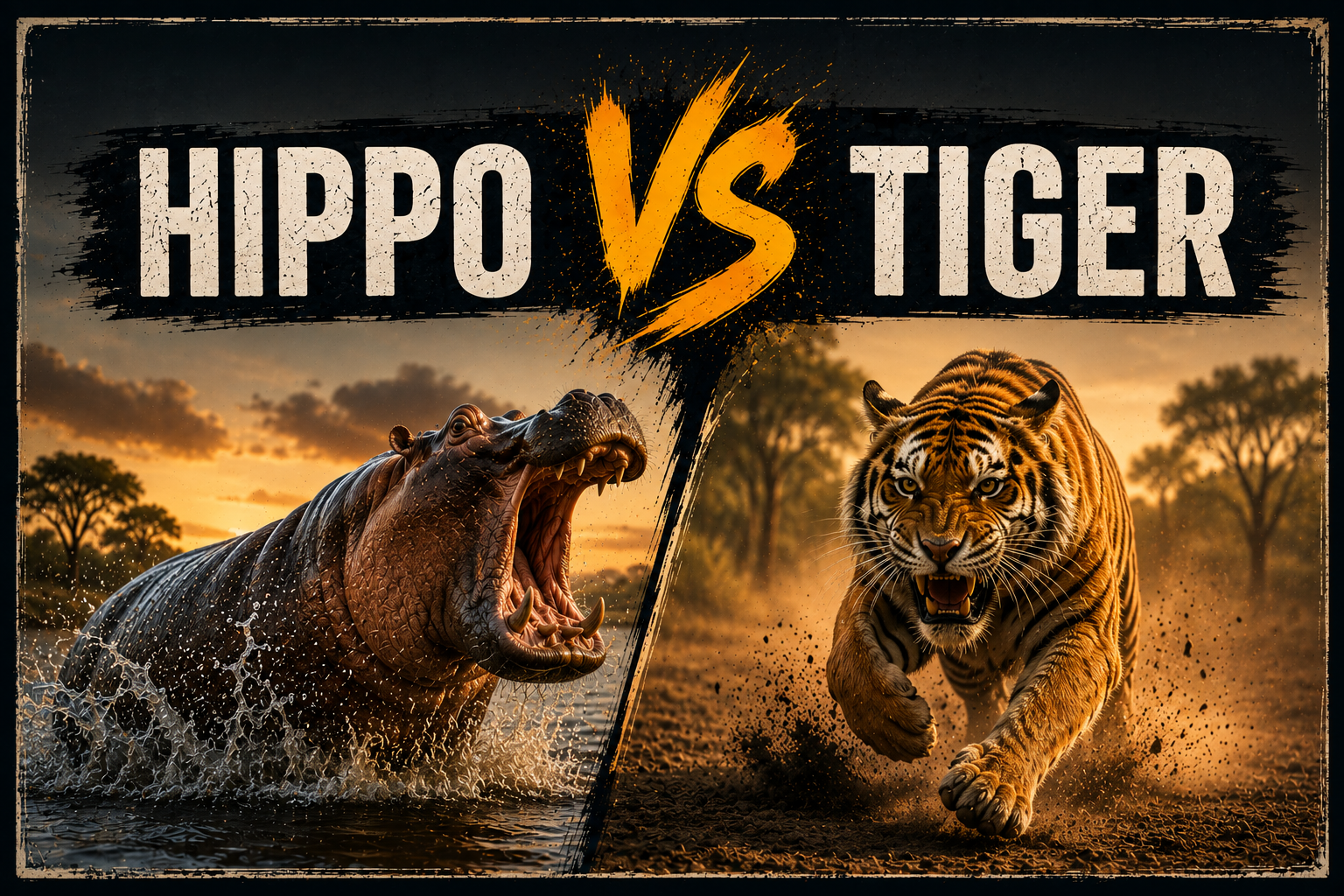
The tiger is the largest cat species on Earth and, unlike the lion, it hunts entirely alone. No pride, no coordinated group strategy, no safety in numbers. Every kill a tiger makes — including gaur, the largest wild bovid on Earth — it makes by itself, through ambush, explosive power, and a neck bite precise enough to kill almost instantly. It is the most individually capable large predator on the planet.
It would still lose to an adult hippopotamus. But it makes a stronger solo case than any animal covered in this series so far.
Hippo vs Tiger: Quick Comparison
| Feature | Hippopotamus | Tiger (Bengal / Siberian) |
|---|---|---|
| Scientific name | Hippopotamus amphibius | Panthera tigris tigris / P. t. altaica |
| Average weight (male) | 1,500–3,200 kg (3,300–7,000 lbs) | 180–310 kg (397–683 lbs) |
| Maximum weight (wild) | ~4,500 kg (9,900 lbs) | ~389 kg (857 lbs) Bengal; ~423 kg (933 lbs) Siberian |
| Height at shoulder | 1.5–1.6 m (5–5.2 ft) | 0.9–1.1 m (3–3.6 ft) |
| Length (head to tail) | Up to 5 m (16.4 ft) | 2.5–3.7 m (8.2–12.1 ft) |
| Bite force | ~1,800 PSI | ~1,050 PSI |
| Claw length | — | ~80 mm (3.1 in) |
| Paw strike force | — | ~4,500 kg estimated |
| Speed | ~30 km/h (19 mph) | 49–65 km/h (30–40 mph) |
| Skin thickness | ~5 cm (2 in) | Thin, unprotected |
| Hunting style | Territorial / defensive | Solitary ambush predator |
| Largest verified prey | — | Gaur (~400 kg avg. kill weight; species up to 1,000 kg) |
| Conservation status | Vulnerable | Endangered |
| Wild population | ~115,000–130,000 | ~4,500–5,000 total |
Which Tiger?
There are six surviving tiger subspecies, varying considerably in size, habitat, and hunting behaviour.
The Bengal tiger (Panthera tigris tigris) is the most numerous, with approximately 2,500 to 3,000 individuals remaining in India, Bangladesh, Bhutan, and Nepal. Adult males typically weigh 180 to 258 kg, with the largest wild Bengal ever recorded at 389 kg. They are highly adaptable hunters experienced in diverse environments including forests, grasslands, and the mangrove wetlands of the Sundarbans — an important detail for any discussion involving water.
The Siberian tiger (Panthera tigris altaica) — also called the Amur tiger — inhabits the cold forests of Russia’s Far East and northeastern China. It is generally considered the largest tiger subspecies, with males averaging 180 to 300 kg and exceptional individuals reaching 423 kg. The largest captive Siberian tiger on record weighed over 454 kg. They are powerfully built, with longer fur adapted to cold climates. Approximately 500 to 600 individuals survive in the wild.
For this comparison, the Siberian tiger represents the most physically imposing individual, while the Bengal tiger provides the most ecologically relevant scenarios — particularly regarding water. Both are considered across the article.
Size: A Closer Gap Than You Might Expect
The hippo vs tiger size comparison is the most interesting weight ratio in the series since the hippo vs rhino, and for a different reason.
A typical adult hippo bull weighs 2,000 kg. A large Siberian tiger weighs 280 kg. That is a ratio of approximately 7:1 — narrower than the hippo vs lion comparison (8–12:1) and vastly narrower than hippo vs elephant. An exceptional Siberian at 423 kg against an average hippo at 1,500 kg narrows the ratio further to roughly 3.5:1.
This does not make the tiger a likely winner. But it does mean the tiger’s individual weapons and capabilities are operating against a somewhat less extreme size disadvantage than the lion’s were. The tiger brings more mass, more bite force, longer claws, and — crucially — a hunting ability refined over millions of years for attacking large animals alone, without the assistance that makes lion predation on big prey viable.

The Tiger’s Arsenal
Bite Force and Killing Method
The tiger’s bite force is measured at approximately 1,050 PSI for Bengal tigers, with Siberian tigers at around 950 PSI — both significantly higher than a lion’s 650 PSI, and the highest of any felid after the jaguar’s 1,500 PSI.
The tiger kills almost entirely through a neck bite or throat bite — gripping the vertebrae or windpipe of prey until death by cervical dislocation or suffocation. This method is applied to prey ranging from 50 kg deer to gaur averaging around 400 kg in documented kills, and the precision of the bite is one of the tiger’s most developed physical capabilities. A tiger locating the correct anatomical position for a killing neck bite on a gaur requires accurate targeting through dense muscle and thick hide.
Against a hippo, this killing method is structurally inaccessible for the same reasons it is inaccessible to a lion: the hippo’s neck is too wide, its hide too thick, and its head too mobile for a tiger to secure and maintain the grip required for suffocation.
Claws
A tiger’s retractable claws reach approximately 80 mm (3.1 inches) in length — more than double the lion’s 38 mm. These claws are the primary grip mechanism in ambush hunting: the tiger uses them to seize and hold prey as the killing bite is applied. A tiger’s forelimb delivers an estimated striking force of up to 4,500 kg — enough to knock a large horse off its feet.
Against a hippo’s 5 cm hide, tiger claws cause deeper surface wounds than lion claws. They are unlikely to penetrate to the muscle beneath in a single strike, but sustained claw raking across the same area — as would occur during a prolonged ambush — could create meaningful lacerations even through that thickness of dermal protection. This represents a marginal but genuine difference from the lion comparison: the tiger’s claws are weapons that partially engage even against hippo hide.
Speed and Ambush
Tigers reach sprint speeds of 49 to 65 km/h (30 to 40 mph) — faster than the hippo’s 30 km/h and faster than a lion. Their hunting method is almost exclusively ambush: concealment followed by an explosive charge covering the final 10 to 20 metres, aiming to make contact before the prey can effectively respond.
The ambush strategy is the tiger’s most significant tactical advantage over the hippo on land. A hippo that has not detected an incoming tiger in time cannot bring its defensive capabilities — the jaw, the charge, the bodyweight — to bear before the tiger makes initial contact. Whether that initial contact is sufficient to change the outcome is a different question, but the tiger’s ability to make first contact on its own terms is more realistic than the lion’s.
The Tiger as a Large-Prey Specialist
This is the detail that makes the tiger comparison genuinely different from the lion comparison, and worth examining carefully.
Tigers routinely kill the gaur — the Indian bison, the largest bovid in the world. Adult male gaur can reach 1,000 kg or more, though most individuals killed by tigers are considerably smaller: a peer-reviewed study published in Ecology and Evolution, tracking 24 radio-collared tigers in Thailand and examining necropsy data from 82 gaur kills, found an average weight of approximately 398 kg for gaur actually killed — well below the species’ maximum size, as tigers tend to target younger or smaller individuals. Even at this more modest average, the gaur is a formidable animal — powerfully built, with thick necks, strong hooves capable of lethal kicks, and horns that can gore a tiger fatally. A tiger at 180-200 kg regularly kills gaur roughly twice its own weight, through ambush and a single precision neck bite.
An average gaur kill at roughly 400 kg is approximately 2 times the weight of a Bengal tiger; the largest gaur, at 1,000 kg, would be closer to 5 times its weight. An average adult hippo at 2,000 kg is roughly 10 times the weight of the same tiger. The gaur kill demonstrates that tigers can reliably bridge a 2:1 weight gap through technique and ambush, and occasionally bridge gaps closer to 5:1 against the largest individuals. The question is whether they can bridge 10:1.
The answer is almost certainly no — for three reasons the gaur comparison does not resolve. First, the gaur is a bovid with relatively standard hide and a neck that a tiger can grip and hold. The hippo’s hide and body width make the killing bite structurally inaccessible in a way the gaur’s anatomy does not. Second, the gaur’s defensive weapons — kicks and horns — are dangerous but targeted. The hippo’s primary defensive weapon is its jaw, which opens to 150 degrees and delivers 1,800 PSI anywhere the hippo’s head can reach — making close proximity catastrophically dangerous for the tiger in a way that proximity to a gaur is not. Third, the gaur cannot counterattack while being held by the neck as effectively as a hippo can pivot and strike.
The gaur kill establishes the tiger as the most capable individual large-prey predator in this series of comparisons. It does not establish that the tiger can kill a hippo — only that it operates at a scale where the attempt is more conceivable than for the lion.
The Hippo’s Defences
Against the tiger, the hippo’s defensive position is slightly more complicated than against the lion — but the outcome is the same.
The 1,800 PSI bite through 50 cm canines remains the decisive factor. A tiger that makes contact with the hippo in an ambush and fails to immediately disengage faces a counterattack from an animal whose jaws, at full closure, can sever or crush any part of a 280 kg tiger’s body. The hippo does not need precision: a jaw that opens to 150 degrees and closes on any part of a tiger makes contact fatal. A tiger’s survival in a hippo encounter requires not being bitten — which requires maintaining a level of positional awareness and mobility that becomes increasingly difficult if the ambush drags into sustained combat.
The 5 cm hide reduces the effectiveness of the tiger’s claws and bite force, though less completely than it reduces the lion’s. A tiger bite at 1,050 PSI causes surface damage to hippo hide. Sustained claw contact at the same location creates potential for deeper penetration over time. Neither is likely to cause incapacitating injury before the hippo’s counterattack resolves the situation.
The 30 km/h charge remains a threat the tiger cannot absorb. Even at 65 km/h, the tiger’s speed is an escape mechanism, not a collision-resistance mechanism. A hippo charge at 30 km/h from 2,000 kg delivers energy the tiger cannot absorb and survive.
Do Hippos and Tigers Ever Meet?
No — and this is the starkest habitat separation in the entire comparison series.
Common hippos live in sub-Saharan Africa. Tigers live in South and Southeast Asia and the Russian Far East. Their ranges have not overlapped for thousands of years, if ever. There are no documented wild encounters between hippos and tigers, no historical accounts of either species engaging the other, and no shared habitat where such an encounter could plausibly occur under natural conditions.
The hippo vs tiger comparison is entirely hypothetical — a thought experiment about two apex-level animals from different continents meeting under artificially equal conditions. This is part of what makes it so searched: the outcome is entirely speculative, and speculation invites debate.

The Sundarbans Exception
There is one scenario that partially bridges the habitat gap, though it remains hypothetical: the Sundarbans.
The Sundarbans is the world’s largest mangrove delta, spanning the coastal regions of Bangladesh and India. It is the only place on Earth where Bengal tigers live in a predominantly aquatic, tidal environment. Sundarbans tigers swim between islands regularly, hunt in shallow tidal channels, and have adapted to a lifestyle far more aquatic than any other tiger population. They take prey in and near water with regularity.
If any tiger could be said to have relevant experience in a semi-aquatic environment, it is a Sundarbans Bengal. In shallow tidal water — knee to waist depth — a Sundarbans tiger retains more of its land capabilities than a typical tiger would in any water environment. It can still sprint short distances, still launch from the water surface, still apply its claws and bite effectively.
This does not mean a Sundarbans tiger would defeat a hippo in water. A hippo in any depth of water is in its natural element, and its bite remains lethal regardless of water depth. But it is the closest real-world approximation to a tiger-hippo water encounter — and it represents a more interesting scenario than the complete aquatic incapacity a typical tiger would face.
Water vs Land
On Land
The tiger has the most credible individual case of any animal in this comparison series. Its ambush capability, 65 km/h sprint speed, 1,050 PSI bite, and 80 mm claws make initial contact more realistic than for the lion, and its ability to cause damage through hippo hide slightly more meaningful. But the outcome remains the same: the hippo’s counterattack, if the tiger cannot immediately disengage, is fatal. A bite from a hippo jaw anywhere on a 280 kg tiger’s body is not survivable. The tiger’s tactical advantage is in making first contact — not in what happens after.
In Water
Hippo wins completely. The Sundarbans Bengal’s aquatic experience reduces the disadvantage marginally but does not change the fundamental dynamic: the hippo is in its preferred environment, its bite is fully accessible, and its bulk is not a disadvantage below the waterline. A tiger in deep water cannot sprint, cannot anchor for a sustained hold, and cannot effectively disengage from a hippo that has made contact.

Who Would Win? The Verdict
One tiger vs one adult hippo on land: The hippo wins. The weight ratio — 7:1 in a typical matchup, down to roughly 4:1 with the largest Siberian tigers — combined with the hippo’s impenetrable hide, lethal jaw, and territorial aggression produces the same outcome as every other comparison in this series involving an animal of this size range. The tiger’s individual capabilities are the most impressive of any solo contender, but they are not sufficient to overcome the physical realities of the matchup.
Multiple tigers: Unlike the lion comparison, where a pride’s coordinated hunting creates a realistic if rare path to a hippo kill, tigers are solitary by nature. Two or three tigers converging on a single hippo is not a natural behaviour and would not reflect any instinct or learned hunting pattern in the species. A large group of tigers attacking a hippo simultaneously is less plausible than a lion pride doing so, because the collective hunting capability simply is not part of the tiger’s behavioural repertoire.
Tiger vs hippo calf: Realistic. A tiger would readily take a hippo calf that was separated from its mother, in the same way a pride of lions targets hippo calves. A calf of 30 to 50 kg is well within the range of prey any tiger would pursue.
The tiger is the most compelling individual opponent in the series. It has the best solo case of any animal compared to the hippo so far. It still loses — but it loses to an animal that almost nothing can beat in a direct confrontation.

Conservation: Both Endangered by the Same Forces
Tiger Conservation
The tiger is one of the most endangered large mammals on Earth. Total wild population across all subspecies is estimated at approximately 4,500 to 5,000 individuals — a catastrophic decline from a population exceeding 100,000 a century ago.
All six surviving subspecies are classified as Endangered by the IUCN Red List. Three subspecies — the Bali tiger, Javan tiger, and Caspian tiger — went extinct in the twentieth century. The South China tiger (P. t. amoyensis) is considered functionally extinct in the wild, with perhaps 100 individuals surviving in captive facilities.
The primary drivers of tiger decline are habitat loss from agricultural and urban expansion, prey depletion, and illegal poaching for traditional medicine markets — particularly in China, Vietnam, and other parts of Southeast Asia, where tiger bones, skin, and organs command high prices despite being traded illegally. An adult tiger pelt can fetch thousands of dollars on black markets.
Conservation efforts — particularly Project Tiger in India, established in 1973 — have produced measurable results in some populations. India’s tiger count has increased significantly under intensive protection, with approximately 3,000 tigers now estimated in the country. Russia’s Siberian tiger population has also stabilised and partially recovered from a low of around 330 individuals in the 1940s to the current 500 to 600.
Hippo Conservation
The common hippo’s estimated wild population of 115,000 to 130,000 is declining under pressure from habitat loss and hunting, though it remains vastly larger than any tiger subspecies’ population. Its Vulnerable classification reflects the direction of the trend rather than immediate crisis-level numbers.
Both species share one of conservation’s most frustrating dynamics: they are among the world’s most globally recognised and admired animals, and both continue to decline despite that recognition. The gap between public awareness and effective protection remains one of the defining challenges of wildlife conservation in the twenty-first century.
Frequently Asked Questions
Who would win in a fight between a hippo and a tiger?
The hippo wins in a direct confrontation. Despite the tiger being the most capable individual predator in this comparison series — with a bite force of 1,050 PSI, 80 mm claws, and the ability to reliably kill gaur averaging around 400 kg alone — the hippo’s 7:1 weight advantage, 5 cm hide, and 1,800 PSI bite make it a match no single tiger can win. The tiger’s best scenario is making contact through ambush and disengaging before the hippo counterattacks.
Is a tiger stronger than a lion in a hippo context?
Yes — the tiger makes a meaningfully stronger individual case than the lion. It is heavier, has a higher bite force (1,050 vs 650 PSI), has longer claws (80 vs 38 mm), and is an experienced solo hunter of prey up to 4.5 times its own body weight. However, the lion’s pride-hunting advantage means that in practical terms, lions remain the more plausible threat to adult hippos in the wild — not because a single lion is stronger, but because ten lions can do what one tiger cannot.
Could a tiger kill a hippo?
Not a healthy adult hippo under normal conditions. A severely injured, isolated, or very young hippo could potentially be killed by a tiger. The gaur comparison — tigers reliably killing animals averaging around twice their own weight, and occasionally individuals up to 5 times their weight — is the strongest evidence for the tiger’s individual capability, but a hippo at roughly 10 times a tiger’s weight presents both a larger size gap and defensive challenges (hide, jaw geometry, aquatic escape) that a gaur does not.
Do tigers and hippos live in the same places?
No. Common hippos are native to sub-Saharan Africa. Tigers are native to South and Southeast Asia and the Russian Far East. The two species occupy entirely different continents and have not shared habitat in recorded history. Their comparison is purely hypothetical.
Which tiger is biggest?
The Siberian (Amur) tiger is generally considered the largest subspecies, with males averaging 180 to 300 kg and exceptional individuals reaching 423 kg in the wild. The largest wild tiger ever recorded was a Bengal at 389 kg. In captivity, Siberian tigers have exceeded 450 kg.
Are tigers endangered?
Yes — all six surviving tiger subspecies are classified as Endangered by the IUCN. The total wild population across all subspecies is estimated at 4,500 to 5,000, down from over 100,000 a century ago. Three subspecies went extinct in the twentieth century. India holds approximately 3,000 tigers — the largest single-country population.
Could a Bengal tiger in the Sundarbans beat a hippo in water?
No, but it represents the most plausible water-encounter scenario in the comparison. Sundarbans Bengal tigers are highly adapted to aquatic environments, regularly swimming between islands and hunting in shallow tidal channels. In shallow water, they retain more capability than a typical tiger would. In any meaningful depth, the hippo’s complete aquatic dominance — bite force fully accessible, mass fully supported, territorial aggression at maximum — produces the same outcome as in any other water environment.
Explore more on Hippoworlds: hippo vs gorilla · hippo vs lion · hippo vs elephant · hippo vs rhino · hippo vs crocodile

I’ve been writing and running HippoWorlds’ content since 2019. I lived in Angola and was lucky enough to see hippos in the wild in Botswana and South Africa — I’m not a scientist, but a curious enthusiast dedicated to making this site a serious reference on the species.